Selecting a competent laravel development company is one of the most consequential decisions a business can make when building or modernizing software. A web application often serves as the operational engine of a company—powering revenue generation, customer interactions, internal operations, and proprietary data workflows. When that foundation is engineered well, software scales predictably, adapts quickly to changing business requirements, and remains secure under load. When engineered poorly, technical debt accumulates rapidly, leading to frequent outages, sluggish database queries, security vulnerabilities, and ballooning refactoring expenses that derail product roadmaps.
Laravel projects vary widely in scope and architectural complexity. A venture-backed startup may require a high-concurrency software-as-a-service (SaaS) platform with multi-tenant data isolation and automated subscription billing. A mid-market e-commerce company might need a custom inventory synchronization pipeline linking an ERP, logistics carriers, and a high-volume storefront. Another enterprise may need to refactor a fragile, legacy procedural PHP application into a maintainable, modern framework.
Given this spectrum of needs, the cheapest development quote or the largest digital agency with thousands of generalist employees is rarely the optimal partner. Cheap quotes often conceal outsourced junior contractors, absence of automated testing, hardcoded dependencies, and poor architectural planning. Conversely, giant agencies frequently charge enterprise retainer premiums while delegating day-to-day execution to rotating account managers with minimal framework specialization.
This guide provides a practical, objective framework for technical decision-makers and non-technical business leaders evaluating development partners. You will learn what authentic framework expertise looks like, how to evaluate vendors across technical depth and business acumen, how development models (in-house vs. freelance vs. agency) compare, and the critical questions you must ask before signing a statement of work.
1. What Is Laravel Development?
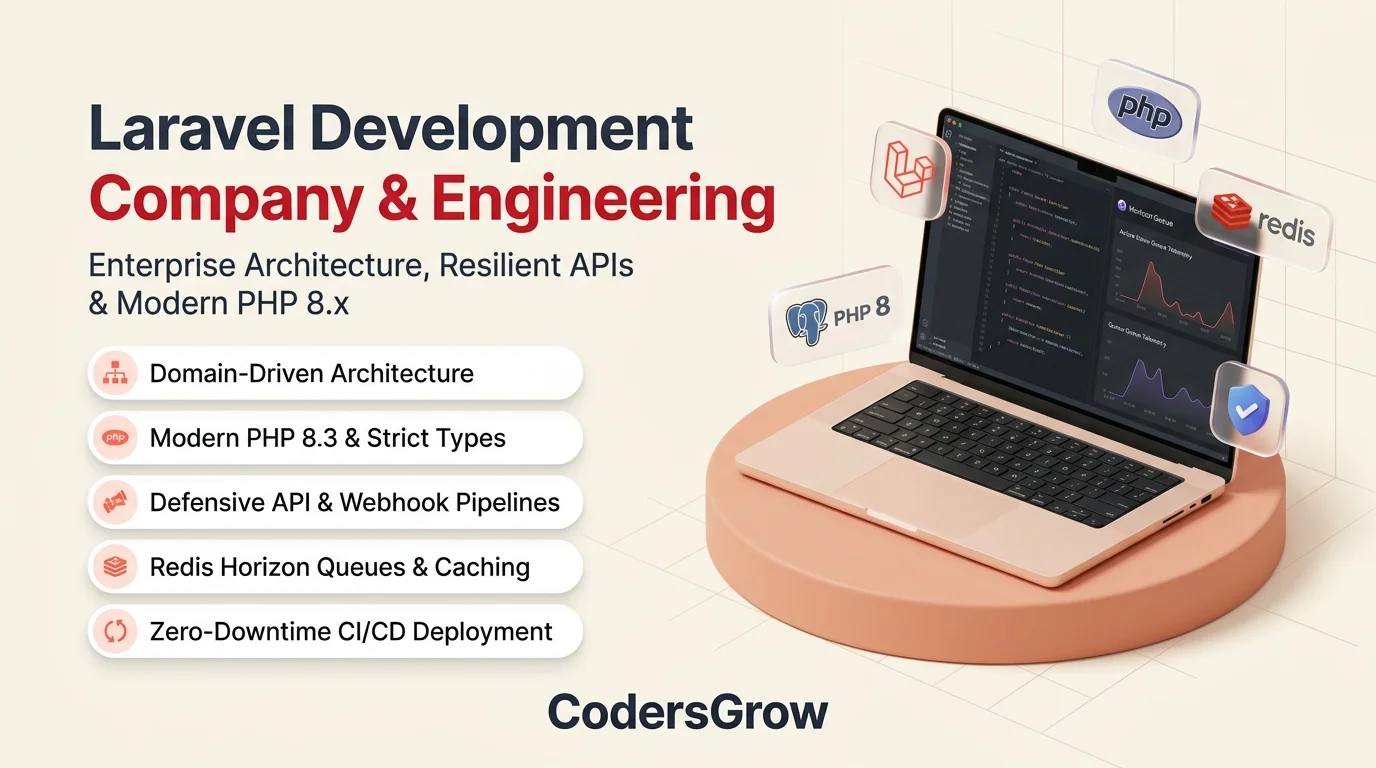
Laravel development refers to building web applications, backend APIs, and digital products using Laravel—an open-source PHP web framework created by Taylor Otwell in 2011. Designed around the Model-View-Controller (MVC) architectural pattern, Laravel was engineered to eliminate repetitive boilerplate code while providing an expressive, elegant syntax for common web development tasks such as routing, authentication, session management, database migrations, and queuing systems.
Laravel’s Role in Modern PHP
Historically, PHP suffered from an inconsistent reputation due to unstandardized procedural codebases popular in the early 2000s. Modern PHP (versions 8.1, 8.2, and 8.3+) is an entirely different language: strictly typed, highly performant, featuring JIT compilation, attributes, fibers for asynchronous execution, and rigorous object-oriented paradigms as documented in the official PHP documentation.
Laravel catalyzed this modernization. It elevated PHP into a premier enterprise language by combining mature engineering principles with developer velocity. Rather than reinventing foundational components, Laravel integrates battle-tested libraries—such as Symfony HTTP components, Monolog for logging, and Flysystem for cloud storage abstractions—into a cohesive, elegant framework backed by a rich first-party ecosystem (Horizon, Pulse, Sanctum, Nova, Forge, Octane) as outlined in the Laravel official documentation.
+-----------------------------------------------------------------------+
|                       Client Requests (Web / Mobile)                  |
+-----------------------------------+-----------------------------------+
                                    |
                                    v
+-----------------------------------------------------------------------+
|                    HTTP Routing & Middleware Pipeline                 |
|             (Rate Limiting, CORS, Sanctum/Passport Auth, CSRF)        |
+-----------------------------------+-----------------------------------+
                                    |
                                    v
+-----------------------------------------------------------------------+
|                     Controllers / Action Classes                      |
|                  (Form Request Validation, Policies)                  |
+-----------------------------------+-----------------------------------+
                                    |
            +-----------------------+-----------------------+
            |                                               |
            v                                               v
+-----------------------+                       +-----------------------+
|  Eloquent Models &    |                       |   Background Jobs &   |
|  Database Layer       |                       |   Queues (Redis/SQS)  |
| (PostgreSQL / MySQL)  |                       |  (Emails, Webhooks,   |
+-----------+-----------+                       |   Async Processing)   |
            |                                   +-----------+-----------+
            v                                               |
+-----------------------+                                   v
| Caching Layer (Redis) |                       +-----------------------+
| Query Cache, Sessions |                       | Third-Party Integrations|
+-----------------------+                       | (Stripe, ERPs, APIs)  |
+-----------------------------------------------------------------------+
Why Businesses Choose Laravel
Organizations investing in custom web development services frequently select Laravel because it bridges the gap between rapid time-to-market and enterprise-grade stability:
- Ecosystem Maturity and Velocity: Laravel provides official, first-party solutions for authentication scaffolding (Breeze, Jetstream), API tokenization (Sanctum), OAuth2 servers (Passport), background queue telemetry (Horizon), and distributed application monitoring (Pulse). This ecosystem allows engineering teams to focus on custom business logic rather than rebuilding foundational infrastructure.
- Standardized Architecture: Unlike un-opinionated micro-frameworks where five developers might organize code in five conflicting ways, Laravel establishes consistent conventions. New engineers can navigate directory structures, service providers, database seeders, and Artisan console commands immediately.
- Robust Database Abstraction: Laravel’s Eloquent ORM (Object-Relational Mapper) enables developers to interact with database schemas using intuitive object-oriented syntax, while query builders, database migrations, and schema seeders make multi-developer collaboration reproducible across local, staging, and production environments.
- Asynchronous Background Processing: Web applications become slow when they execute time-consuming operations (generating PDF reports, processing video files, synchronizing third-party APIs) synchronously during an HTTP request. Laravel features native, unified queue abstractions supporting Redis, Amazon SQS, and database backends, allowing long-running tasks to process asynchronously without degrading user response times.
- Cost-Effective Infrastructure and Hosting: PHP runs efficiently on virtually all cloud infrastructures, Linux distributions, serverless environments (AWS Lambda via Laravel Vapor), and containerized deployments (Docker, Kubernetes). The availability of managed deployment tools reduces ongoing operations overhead compared to more resource-heavy application stacks.
What Types of Applications Can Be Built with Laravel?
Laravel is a versatile general-purpose framework capable of powering a wide variety of custom business systems:
- SaaS Platforms: Multi-tenant web applications featuring recurring subscription billing, user role hierarchies, team workspaces, tenant-scoped databases, and metered usage tracking.
- Custom Admin Panels and Internal Dashboards: Back-office management interfaces for managing catalog data, customer records, inventory balances, and real-time operational metrics.
- Custom Business Management Systems (ERP/CRM): Domain-specific enterprise software tailored to bespoke operational workflows that off-the-shelf software cannot accommodate without painful workarounds.
- Complex E-Commerce Platforms: Headless commerce backends, custom configurators, tiered B2B wholesale portals, multi-vendor marketplaces, and high-SKU stores requiring specialized checkout workflows.
- API Backends for Mobile and Single Page Applications: High-throughput RESTful or GraphQL endpoints serving iOS, Android, Vue.js, React, or Next.js client applications with tokenized session handling and granular rate limiting.
- Booking and Scheduling Engines: Systems managing complex calendar logic, resource allocation, automated reminders, time-zone conversions, and real-time availability locks.
- Customer and Vendor Portals: Secure, authenticated portals where clients access proprietary documents, view shipment tracking milestones, submit support tickets, and execute payments.
When Laravel Is an Excellent Choice
Laravel is ideal when you need to build a custom, proprietary business system with bespoke workflows and database relationships; when you are building a SaaS product where developer velocity and rapid feature iteration dictate competitive survival; when your application demands seamless integration with multiple external APIs and payment processors via background queues; and when you need long-term maintainability supported by a massive global developer community and predictable LTS framework release cycles.
When Laravel May Not Be the Optimal Choice
A reputable technology partner will always identify when Laravel is not the best tool for your requirements:
- Content-Heavy Marketing Websites: If your primary requirement is an editorial marketing site, corporate blog, or brochure portfolio that non-technical editors update daily, platforms built on WordPress development or headless CMS architectures are generally more cost-effective and easier to maintain.
- Pure Low-Latency Computational Engines: For high-frequency algorithmic trading, heavy real-time machine learning inference, computer vision, or raw microsecond networking, systems languages such as Go, Rust, or C++ are better suited for the computational core.
- Pure Real-Time P2P Streaming: While Laravel handles WebSockets cleanly via Laravel Reverb or Pusher, applications whose sole function is ultra-low-latency peer-to-peer video streaming or high-volume telemetry ingestion may achieve higher raw throughput using specialized event-loop runtimes like Node.js or Elixir.
2. What to Look for in a Laravel Development Company
When vetting a Laravel development agency, business owners often struggle to distinguish between superficial marketing claims and authentic technical capability. Evaluating a prospective development partner requires looking beyond portfolio screenshots into their engineering discipline, business mindset, and operational reliability.
                  EVALUATING A LARAVEL PARTNER
                                |
    +---------------------------+---------------------------+
    |                           |                           |
    v                           v                           v
1. TECHNICAL DEPTH          2. BUSINESS VALUE           3. DELIVERY & HYGIENE
- Modern PHP 8.x idioms     - Requirements discovery    - Automated test suites
- Queue / Caching arch.     - Domain modeling           - CI/CD deployment pipelines
- Security & OWASP rigor    - Pragmatic ROI focus       - Comprehensive documentation
Technical Expertise
Framework specialization requires far more than knowing basic Laravel syntax. A qualified Laravel development company demonstrates depth across several core disciplines:
- PHP 8.x Mastery: Developers should write strict, typed PHP utilizing modern constructs (enums, match expressions, constructor property promotion, readonly classes, custom attributes). If an agency’s code samples still resemble PHP 5.6 procedural code wrapped in a Laravel controller, avoid them.
- Relational Database Design and Query Optimization: They must understand relational database normal forms, foreign key cascading constraints, indexing strategies (composite, covering, and partial indexes), and query execution plans (
EXPLAIN ANALYZE). They must demonstrate a clear understanding of the “N+1 query problem” and know how to resolve it using Eloquent eager loading (with()), custom join queries, or database views. - REST API Architecture: They should follow standardized RESTful conventions, utilize API Resources for strict response transformation, enforce consistent HTTP status codes, implement API versioning, and handle paginated responses efficiently.
- Authentication and Authorization: They should possess deep experience configuring robust authorization mechanisms using Laravel Gates, Policies, and middleware, alongside standardized authentication mechanisms (Sanctum for SPAs/mobile apps, Passport for full OAuth2 specifications).
- Queues, Background Jobs, and Caching: They should know how to configure Redis for high-throughput caching, session management, and queue orchestration. They must understand job serialization, idempotency, retry backoff strategies, dead-letter failure queues, and queue monitoring via Laravel Horizon.
- Testing Discipline: They must write automated tests. Inquire about their automated testing standards across unit tests (PHPUnit/Pest), HTTP integration tests, and browser end-to-end testing. An agency that does not write automated tests is leaving quality assurance to your end users.
- Source Control Hygiene: They should maintain strict Git workflows (trunk-based development or GitHub Flow), utilize descriptive commit conventions, enforce branch protection, and execute mandatory peer pull-request reviews.
Business Understanding
A competent software engineer writes code that solves a technical problem; a valuable development partner builds software that advances a business objective.
Your development partner must demonstrate genuine interest in your business model, revenue mechanics, user personas, unit economics, and operational bottlenecks. If an agency immediately quotes a price after hearing a three-sentence project description without probing into your operational workflows, edge cases, compliance obligations, or long-term goals, they are treating your project as a commodity ticket-punching exercise. Look for partners who ask challenging questions, identify flawed assumptions, and suggest simpler, more cost-effective alternatives.
Communication and Transparency
Software development is an iterative, communication-intensive endeavor. Misunderstandings regarding requirements represent the single largest source of software waste and budget overruns. Evaluate how prospective partners communicate:
- Communication Cadence: Do they provide weekly asynchronous video walkthroughs, clear sprint summaries, and structured milestone demonstrations?
- Requirement Clarification: Do they document assumptions in writing before writing code, or do they rely on vague verbal agreements?
- Tooling and Visibility: Will you have direct access to their project management systems (Jira, Linear, ClickUp, or Basecamp) and Git repositories, or will your visibility be shielded behind an account manager?
- Problem Escalation: When technical roadblocks or scope ambiguities arise, do they communicate immediately with proposed solutions, or do they hide delays until the delivery deadline has passed?
Development Practices and Operational Hygiene
Professional software development requires systematic operational hygiene:
- Clean Code Organization: They should avoid “fat controllers” and bloated Eloquent models by encapsulating complex business logic into Single-Responsibility Action classes, Service layers, Domain-Driven Design (DDD) concepts, or Form Request validation objects.
- Continuous Integration and Continuous Deployment (CI/CD): They must utilize automated CI/CD pipelines (GitHub Actions, GitLab CI, or Bitbucket Pipelines) that automatically run static analysis (PHPStan / Psalm), code style linters (Laravel Pint), and automated test suites on every pull request before code can be merged.
- Environment Separation: They should enforce strict separation between local development, staging/testing environments, and production environments, with automated zero-downtime deployments (via tools like Laravel Forge, Envoyer, or custom Docker containers).
Scalability Mindset
Scalability is not an accidental byproduct; it is an architectural decision made on day one. A qualified partner designs your system so that increasing user demand does not require complete architectural rewrites. They understand how to design stateless application servers, decouple file storage to cloud object storage (AWS S3, Cloudflare R2), offload intensive calculations to background workers, partition database workloads, and implement multi-layer caching strategies across Redis and application layers.
Security Posture
Security must be embedded throughout the software development lifecycle, adhering to standards established by the OWASP Top 10 Project. A reputable Laravel company enforces strict defenses: robust input sanitization and Form Request validation to prevent Cross-Site Scripting (XSS); leveraging Eloquent’s parameterized PDO bindings to prevent SQL Injection; verifying CSRF token validation on all state-changing HTTP requests; enforcing strict role-based access control (RBAC) via Laravel Policies; managing sensitive API keys and database credentials strictly through environment variables (.env); and establishing automated dependency vulnerability scanning using Composer audit tools and Dependabot.
Post-Launch Support and Reliability
A web application is a living asset that requires continuous maintenance. Before entering an agreement, evaluate how the company approaches post-launch reality: Do they offer formal Service Level Agreements (SLAs) for emergency incident resolution? How do they handle routine security patches, framework major version upgrades, database index maintenance, and third-party API deprecations? A partner that abandons you the moment the application is deployed leaves your business vulnerable to disruption.
3. Laravel Development Services to Compare
When auditing a laravel development services company, you will encounter a variety of specialized offerings. Understanding what these services entail helps you align your specific project requirements with the vendor’s demonstrated strengths.
+---------------------------------------------------------------------------------------------------+
|                                  CORE LARAVEL SERVICE DOMAINS                                     |
+---------------------------------+---------------------------------+-------------------------------+
| 1. APPLICATION ENGINEERING      | 2. ARCHITECTURE & INTEGRATIONS  | 3. LIFECYCLE & OPTIMIZATION   |
+---------------------------------+---------------------------------+-------------------------------+
| - Custom Web Applications       | - REST & GraphQL API Dev        | - Performance Optimization    |
| - SaaS Platform Architecture    | - Payment & ERP Integrations    | - Framework Upgrades & Migr.  |
| - Custom CRM & ERP Portals      | - Webhook Synchronization       | - Long-Term Code Maintenance  |
| - Bespoke E-Commerce Backends   | - Third-Party Data Pipelines    | - Security Audits & Hardening |
+---------------------------------+---------------------------------+-------------------------------+
- Custom Laravel Development: Ground-up engineering of bespoke web applications tailored precisely to unique operational workflows. Ideal when off-the-shelf software forces your company to compromise core business processes, or when your product idea requires proprietary logic and database models through custom software development.
- Laravel Web Application Development: Developing responsive, high-performance browser applications backed by robust server-side Laravel architecture and modern frontend interfaces (Vue, React, Inertia.js, or Livewire).
- Laravel API Development: Architecting, building, and documenting high-performance, secure RESTful or GraphQL APIs that serve as the data layer for web frontends, mobile applications, IoT devices, or third-party partner integrations.
- Custom SaaS Application Development: Building multi-tenant software-as-a-service platforms. This includes self-service registration, subscription billing lifecycles (Stripe, Lemon Squeezy, Paddle), usage metering, tenant database separation, automated team invitations, and role-based permissions.
- Laravel E-Commerce & Marketplace Development: Engineering complex e-commerce platforms that exceed the native capabilities of standard platforms like Shopify. This includes custom product configurators, multi-vendor marketplace commission splits, international multi-currency checkouts, and custom inventory allocation rules.
- Custom Admin Panels, Portals, and Dashboards: Developing internal tooling, customer self-service portals, or back-office administration interfaces using Laravel Filament, Laravel Nova, or bespoke UI components.
- Legacy PHP to Laravel Migration & Modernization: Refactoring or re-architecting older, monolithic PHP applications (raw procedural PHP, CodeIgniter, CakePHP, Yii, Zend) into clean, modern, modular Laravel architectures without halting ongoing business operations.
- Laravel Performance Optimization: Auditing, profiling, and optimizing slow Laravel applications. This involves analyzing slow database queries, resolving N+1 Eloquent relationships, configuring Redis caching layers, offloading blocking jobs to queues, optimizing assets, and tuning PHP-FPM configurations.
- Third-Party API & Payment Gateway Integration: Connecting your Laravel application to external software ecosystems: payment gateways (Stripe, PayPal, Adyen), ERP systems (SAP, NetSuite), CRM platforms (HubSpot, Salesforce), and shipping providers (EasyPost, FedEx).
- Ongoing Laravel Maintenance & Security Audits: Providing proactive framework version updates, security vulnerability patching, third-party dependency updates, bug resolution, uptime monitoring, and scheduled database maintenance.
4. In-House vs. Agency vs. Freelance Laravel Developers
When planning a Laravel initiative, businesses can source engineering talent through three primary models: hiring full-time in-house developers, contracting freelance developers, or partnering with an established Laravel development agency. Each engagement model features distinct structural trade-offs across cost, control, scalability, and risk.
| Factor | In-House Developer | Freelance Developer | Specialized Agency |
|---|---|---|---|
| Direct Cost | High (Salary + Benefits + Payroll Tax) | Low to Moderate Hourly Rates | Moderate to High (Structured Sprints) |
| Overhead & Hiring | High (Recruiting Fees, Hardware, Admin) | Minimal Overhead | Zero Overhead (Turnkey Delivery) |
| Availability | 100% Dedicated (Full-time) | Variable & Split Attention | Predictable Sprint Capacity |
| Skill Breadth | Single discipline / Limited scope | Specialized or Narrow | Cross-Functional (Backend, UI, QA, DevOps) |
| Scalability | Slow (Takes 60-90 days to hire) | Difficult to scale team size | Elastic (Scale up or down per sprint) |
| Knowledge Retention | Vulnerable to employee resignation | High risk upon contract conclusion | Centrally documented & team-shared |
| Project Management | Requires internal technical manager | Requires continuous micro-management | Managed delivery with sprint visibility |
In-House Laravel Developers
Hiring full-time, salaried engineers directly onto your company payroll provides total dedication to your product and culture. However, in addition to competitive base salaries, employers incur taxes, healthcare benefits, equipment, and recruitment fees (often 15–25% of first-year salary). Furthermore, sourcing experienced senior Laravel developers typically takes 60 to 90 days, and a single developer rarely possesses full-stack mastery across database architecture, UI/UX, DevOps, security, and project management.
Best Suited For: Funded technology startups with established technical leadership (CTO) where software is the core proprietary intellectual property, or mature enterprises with steady, year-round engineering backlogs that justify ongoing payroll commitments.
Freelance Laravel Developers
Engaging independent contractors on an hourly or short-term project basis offers lower direct costs and targeted expertise for a specific, isolated task. However, freelancers frequently manage multiple client accounts simultaneously, creating availability bottlenecks during emergencies. Furthermore, if a contractor accepts full-time employment or becomes unresponsive mid-project, your progress can stall without backup coverage.
Best Suited For: Well-defined, small-scale bug fixes, short-term feature extensions, prototype MVPs with flexible deadlines, or companies that already have a technical manager capable of tightly directing and reviewing the contractor’s work.
Specialized Laravel Development Agencies
Partnering with an established company provides immediate access to a complete, cross-functional software team: senior backend Laravel architects, modern frontend developers (Vue/React/Tailwind), database specialists, DevOps engineers, QA testers, and technical project managers. If an individual engineer is unavailable, the agency substitutes another qualified developer without disrupting delivery timelines. While agency rates reflect the cost of maintaining seasoned teams and legal accountability, they provide reliable, turnkey execution.
Best Suited For: Critical business applications, complex SaaS products, legacy refactoring initiatives, and organizations without internal technical staff that require dependable, turnkey software delivery backed by accountability.
5. Laravel Development Company Comparison Framework
When evaluating multiple development companies, avoid relying on subjective sales pitches. Use this structured, objective comparison framework to score prospective vendors across every critical dimension of technical delivery and operational reliability.
| Evaluation Factor | What to Inspect | Critical Questions to Ask the Vendor |
|---|---|---|
| Laravel Expertise | Depth of modern framework usage, familiarity with first-party ecosystem (Horizon, Sanctum, Octane, Filament). | “Which first-party Laravel packages do you deploy most frequently, and why do you choose them over custom code?” |
| PHP Knowledge | Rigorous use of modern PHP 8.x features, strict typing, interfaces, and design patterns. | “How do your developers enforce strict types, and what static analysis tools do you configure in your build pipelines?” |
| Database Architecture | Relational schema design, index strategy, query optimization, handling the N+1 problem. | “Can you explain how you audit and resolve slow Eloquent queries and N+1 query loops in complex views?” |
| API Architecture | Standardized RESTful design, API Resources, status code accuracy, versioning, throttling. | “How do you structure API responses and handle breaking changes across multiple client app versions?” |
| Security Standards | Protection against OWASP Top 10, CSRF, XSS, SQL injection, secrets management, input validation. | “What is your protocol for sanitizing inputs, authenticating API consumers, and managing sensitive environment credentials?” |
| Testing & QA | Automated test suites (Pest / PHPUnit), integration testing, regression prevention. | “What percentage of your codebase is covered by automated unit and feature tests, and do you run them on every pull request?” |
| Scalability Design | Decoupled storage, queue architectures, background jobs, caching strategies (Redis). | “How do you design an application’s architecture to ensure background tasks do not block the primary HTTP request thread?” |
| Deployment & CI/CD | Automated build pipelines, zero-downtime deployment, staging environments, rollback safety. | “Describe your deployment pipeline: How do you deploy code to production without downtime or interrupted user sessions?” |
| Communication Cadence | Structured project visibility, sprint reviews, ticketing tools, direct developer access. | “What tools will we use to track progress, and how frequently will we review working software demos?” |
| Code Documentation | Architecture decision records, README setup guides, inline docblocks, API documentation (Postman/OpenAPI). | “What documentation do you deliver alongside the codebase to ensure an outside developer could take over maintenance?” |
| Maintenance & Support | Post-launch SLAs, framework LTS upgrade roadmaps, security patch responsiveness. | “How do you manage ongoing Laravel minor and major version upgrades once the system is live in production?” |
| IP & Code Ownership | 100% full intellectual property transfer, direct Git repository access, no proprietary vendor lock-in. | “Will our company own 100% of the custom source code and repository access from day one of the project?” |
| Transparent Pricing | Clear Statement of Work (SOW), transparent billing model, explicit change-order protocols. | “How do you define project scope boundaries, and what happens when an unexpected requirement emerges mid-sprint?” |
6. What CodersGrow Offers
As you evaluate potential technology partners, CodersGrow is one web development company you may consider for your custom software and web application initiatives. Based on a disciplined engineering approach, CodersGrow provides specialized development services designed around business stability, clean architecture, and transparent communication.
Rather than positioning as a high-volume outsourcing mill or a generalist agency that attempts to support dozens of unrelated platforms, CodersGrow focuses its engineering practice on modern PHP, the Laravel ecosystem, and custom WordPress/WooCommerce infrastructure.
+-----------------------------------------------------------------------+
|                    CODERSGROW CORE CAPABILITY MATRIX                  |
+-----------------------------------------------------------------------+
|  CUSTOM LARAVEL WEB APPLICATIONS                                      |
|  - Domain-Driven Design (DDD) & Single-Responsibility Actions         |
|  - Multi-Tenant SaaS Platforms with Automated Lifecycle Billing       |
|  - Bespoke Admin Panels & Dashboards (Filament / Custom UI)           |
+-----------------------------------------------------------------------+
|  API ARCHITECTURE & SYSTEM INTEGRATION                                |
|  - Scalable RESTful API Backends with Sanctum Authentication          |
|  - Bi-Directional ERP, CRM, and Payment Gateway Connectors            |
|  - Webhook Ingestion Pipelines with Idempotency & Replay Protection   |
+-----------------------------------------------------------------------+
|  HYBRID LARAVEL + WORDPRESS / WOOCOMMERCE ECOSYSTEMS                 |
|  - Headless Storefront Integrations via Store API / REST              |
|  - Custom High-Performance Microservices for High-Volume Stores       |
|  - Bespoke WooCommerce Plugin & Extension Development                 |
+-----------------------------------------------------------------------+
|  PERFORMANCE OPTIMIZATION & ONGOING CODE CARE                         |
|  - Eloquent Query Profiling & Redis Caching Architectures             |
|  - Framework Version Upgrades & Legacy PHP Modernization              |
|  - Continuous Maintenance, Security Patching & Code Refactoring       |
+-----------------------------------------------------------------------+
Core Capabilities
- Custom Laravel Development: Architecting tailored web applications from scratch, translating complex operational workflows into intuitive, resilient digital systems.
- Custom Software and SaaS Platforms: Engineering scalable multi-tenant platforms, subscription management engines, and customer portals built with robust domain modeling.
- API Development and Integration: Building secure RESTful APIs, webhook ingestion pipelines, and bi-directional synchronizations with external enterprise systems (Stripe, HubSpot, Salesforce, logistics providers, ERPs).
- Bespoke Administration Dashboards: Creating powerful, role-restricted internal management portals that streamline company operations, reporting, and data governance.
- Performance Optimization and Database Profiling: Auditing existing, sluggish Laravel codebases to resolve query bottlenecks, optimize index architectures, implement Redis caching, and stabilize server infrastructure.
- Ongoing Application Maintenance and Enhancements: Providing disciplined framework upgrades, proactive security hardening, continuous feature additions, and technical debt remediation.
- Hybrid Laravel and WordPress/WooCommerce Integrations: Leveraging deep expertise across both platforms to build high-performance hybrid setups—such as using Laravel to power complex background processing, custom portals, or pricing algorithms connected to a WordPress storefront via WooCommerce customization services.
7. How CodersGrow Approaches Laravel Projects
Software projects succeed or fail long before the first line of code is written. CodersGrow approaches Laravel projects through a systematic, multi-phase delivery framework that prioritizes risk reduction, technical clarity, and maintainable architecture.
+---------------------------------------------------------------------------------------------------+
|                            CODERSGROW PROJECT EXECUTION LIFECYCLE                                 |
+-------------------+-------------------+-------------------+-------------------+-------------------+
|  1. DISCOVERY     |  2. ARCHITECTURE  |  3. DEVELOPMENT   |  4. QA & AUDIT    |  5. DEPLOYMENT    |
| - Requirements    | - Schema Modeling | - Strict Typing   | - Automated Tests | - Zero-Downtime   |
| - Risk Assessment | - API Contracts   | - Clean Actions   | - Security Audits | - Monitoring      |
| - Scope Boundaries| - Infrastructure  | - Frequent Demos  | - Load Profiling  | - Maintenance     |
+-------------------+-------------------+-------------------+-------------------+-------------------+
- Requirements Discovery & Domain Mapping: Mapping out your business domain, user personas, operational rules, and success criteria. Edge cases and regulatory requirements are examined upfront to avoid costly mid-project architecture rewrites.
- Technical Planning & Specification: Producing entity-relationship diagrams (ERDs), API contract blueprints, state-machine transitions, and third-party dependency mappings before development begins.
- Architecture & Relational Database Design: Designing database schemas with strict normalization, explicit foreign key constraints, and strategic indexing to ensure data integrity is enforced by the database engine itself.
- UI/UX Workflow Structuring: Structuring interfaces (Blade, Inertia.js, Vue, React, or modern Tailwind CSS) around intuitive user workflows and fast page responsiveness.
- Clean, Modular Development: Developing in focused bi-weekly sprints. Code is written following single-responsibility principles, encapsulating business logic inside dedicated Action classes rather than bloated controllers.
- Automated Testing & Continuous Verification: Pairing every feature with automated unit and integration tests (using Pest or PHPUnit) to verify business logic and API contracts automatically.
- Security Hardening & Code Review: Enforcing strict authorization policies, sanitizing inputs, auditing Composer dependencies, and preventing sensitive data exposure.
- Database Query Profiling & Performance Tuning: Profiling memory utilization and query execution times using Laravel Telescope and Debugbar to eliminate N+1 issues and apply Redis caching.
- Staging Validation & Client Review: Deploying features to an isolated staging environment that mirrors production infrastructure for stakeholder testing and feedback.
- Automated Zero-Downtime Deployment: Executing deployments through automated CI/CD pipelines that handle database migrations, cache clearing, queue worker restarts, and asset compilation seamlessly without downtime.
- Post-Launch Telemetry & Proactive Evolution: Monitoring system health through error monitoring (Bugsnag/Sentry) and server telemetry, accompanied by structured ongoing maintenance.
8. A Professional Laravel Development Workflow
To understand what you should expect from any professional development partner, it helps to review the anatomy of a standardized, industry-grade Laravel development workflow.
+---------------------------------------------------------------------------------------+
|                                TYPICAL SPRINT CYCLE                                   |
+---------------------------------------------------------------------------------------+
| 1. User Story Refinement -> 2. Architecture Plan -> 3. Feature Branch Checkout       |
|                                       |                                               |
|                                       v                                               |
| 4. Write Automated Tests -> 5. Write Business Logic -> 6. Local Static Analysis (Pint)|
|                                       |                                               |
|                                       v                                               |
| 7. Push to GitHub -> 8. CI Pipeline (Tests/Linter) -> 9. Peer Pull Request Review     |
|                                       |                                               |
|                                       v                                               |
| 10. Merge to Develop -> 11. Auto-Deploy to Staging -> 12. Stakeholder Verification    |
+---------------------------------------------------------------------------------------+
Step 1: Requirement Analysis
Deconstructing business requirements into explicit, testable user stories with clear acceptance criteria. Ambiguities are resolved before technical planning begins.
Step 2: Technical Planning
Defining the underlying technical mechanisms: identifying required database tables, service providers, external API endpoints, queue workers, and authorization policies needed to fulfill each user story.
Step 3: Architecture & Database Design
Drafting database migrations, indexing structures, and model relationships. Establishing strict foreign key relationships ensures data integrity is enforced by the database engine itself rather than relying solely on application code.
Step 4: UI/UX Implementation
Translating visual wireframes and component libraries into accessible, responsive interfaces using modern frontend tooling (Tailwind CSS, Alpine.js, Vue, or React) tightly coupled with Laravel routing.
Step 5: Core Laravel Development
Writing the core business logic. Experienced developers organize code into dedicated service classes, query scopes, custom collections, and domain events, keeping controllers thin and declarative:
// Example: Clean, declarative Laravel Controller action delegating to an Action class
namespace App\Http\Controllers;

use App\Actions\Subscriptions\CreateSubscriptionAction;
use App\Http\Requests\CreateSubscriptionRequest;
use Illuminate\Http\JsonResponse;
use Symfony\Component\HttpFoundation\Response;

class SubscriptionController extends Controller
{
    public function store(
        CreateSubscriptionRequest $request,
        CreateSubscriptionAction $action
    ): JsonResponse {
        $subscription = $action->execute(
            user: $request->user(),
            planId: $request->validated('plan_id'),
            paymentMethodId: $request->validated('payment_method_id')
        );

        return response()->json([
            'message' => 'Subscription activated successfully.',
            'data' => $subscription,
        ], Response::HTTP_CREATED);
    }
}
Step 6: API & Integration Development
Constructing API endpoints with standardized Laravel API Resource transformers. Webhook listeners are paired with replay verification and idempotency checks to prevent duplicate data processing if an external service fires the same webhook multiple times.
Step 7: Automated Testing & QA
Writing automated tests to verify code behavior under both normal conditions and unexpected edge cases:
// Example: Pest PHP Feature Test verifying role-based authorization and validation
it('prevents non-admin users from creating team subscriptions', function () {
    $user = User::factory()->create(['role' => 'member']);

    $this->actingAs($user)
        ->postJson('/api/v1/subscriptions', [
            'plan_id' => 'enterprise-tier',
            'payment_method_id' => 'pm_card_visa',
        ])
        ->assertStatus(Response::HTTP_FORBIDDEN);
});
Step 8: Security Review
Auditing route definitions to confirm that appropriate authentication and rate-limiting middleware are applied. Verifying that all Eloquent database operations use parameterized inputs and that output encoding prevents cross-site scripting.
Step 9: Performance Optimization
Inspecting database query counts per request. Adding database eager loading (Model::with(...)) to eradicate N+1 query loops. Configuring Redis cache tags for fast data invalidation and offloading intensive email or notification delivery to queues.
Step 10: Staging & Stakeholder Review
Merging verified branches into a staging environment where clients interact with the live application, test end-to-end workflows, and confirm that deliverables match business expectations.
Step 11: Production Deployment
Triggering automated, zero-downtime deployment scripts that compile assets, run database migrations safely, restart queue workers, and prime application caches without disrupting active user traffic.
Step 12: Ongoing Maintenance & System Evolution
Continuously monitoring application health through centralized logging, responding to dependency security advisories, and scheduling iterative sprint cycles for feature enhancements.
9. Security & Code Quality Standards in Laravel
No web application can be guaranteed “100% secure”—security is not a static milestone, but an ongoing operational discipline. However, Laravel provides exceptional native security mechanisms when implemented by developers who understand how to configure and enforce them correctly.
+-----------------------------------------------------------------------------------------------+
|                                MULTI-LAYERED LARAVEL SECURITY                                 |
+-------------------------------+-------------------------------+-------------------------------+
| REQUEST DEFENSE LAYER         | APPLICATION LOGIC LAYER       | DATA & STORAGE LAYER          |
+-------------------------------+-------------------------------+-------------------------------+
| - Global Rate Limiting        | - Role & Permission Policies  | - Parameterized SQL Queries   |
| - Strict CORS Policy Headers  | - Form Request Sanitization   | - Encrypted Secrets (.env)    |
| - Automated CSRF Tokens       | - Auth via Sanctum/Passport   | - At-Rest Sensitive Data Enc. |
| - Secure Cookie Configuration | - Centralized Exception Log   | - Automated Composer Audits   |
+-------------------------------+-------------------------------+-------------------------------+
- Robust Authentication and Authorization: Using Laravel Sanctum or Passport ensures secure, cryptographically signed token exchange for SPAs and mobile applications. Implementing Laravel Policies ensures that access permissions are centralized in dedicated classes rather than scattered across controllers, preventing broken object-level authorization vulnerabilities.
- Input Validation and Sanitization: Never trust client-side data. Professional developers use dedicated Laravel Form Request classes to enforce strict validation rules before controller execution begins.
- Protection Against Injection and XSS: Laravel’s Eloquent ORM utilizes PDO parameter binding by default for all queries, automatically escaping input parameters and neutralizing SQL injection attempts. In Blade templates,
{{ $variable }}automatically escapes output using PHP’shtmlspecialchars(). - CSRF Prevention: Laravel automatically generates and inspects unique cryptographic CSRF tokens on all incoming
POST,PUT,PATCH, andDELETEHTTP requests via itsVerifyCsrfTokenmiddleware. - Secrets Management: Application secrets—database credentials, API keys, and encryption keys—must reside exclusively in environment variables (
.envfiles) that are never committed to version control repositories. - Automated Dependency Auditing: Regular automated scans using
composer auditand tools like Dependabot alert engineering teams immediately when an open-source library receives a security advisory. - Centralized Logging & Error Handling: Production applications must never display detailed debug error stack traces (such as
APP_DEBUG=true) to public end users. Errors are caught gracefully, logging detailed forensic stack traces to secure platforms like Sentry or Bugsnag.
10. API & Third-Party Integrations in Laravel
Modern business software rarely operates in isolation. A web application typically sits at the center of an interconnected digital ecosystem, exchanging data with payment gateways, enterprise CRMs, marketing platforms, and logistics providers.
Poorly planned integrations are a primary source of application instability: if an external third-party API experiences downtime or network latency, a fragile web application can freeze or crash completely. A professional Laravel development company designs integrations with defensive, resilient architecture.
                      DEFENSIVE API ARCHITECTURE
                                   |
+----------------------------------+----------------------------------+
|                                                                     |
v                                                                     v
OUTBOUND INTEGRATIONS                                   INBOUND WEBHOOKS
(Payment, CRM, Logistics)                              (Stripe, Shopify, ERP)
- Rate-limit aware HTTP clients                         - Cryptographic signature validation
- Asynchronous execution via queues                     - Immediate 200 OK acknowledgment
- Exponential backoff & retry loops                     - Queued background payload processing
- Circuit breaker fault isolation                       - Idempotency & replay deduplication
Common Third-Party Integration Domains
- Payment Gateways: Stripe, PayPal, Adyen, Authorize.net (handling complex webhooks for failed charges, chargebacks, automated invoice generation, and 3D-Secure authentication).
- CRM & Marketing Automation: HubSpot, Salesforce, ActiveCampaign, Klaviyo (synchronizing customer lifecycles, lead scoring, and deal stages).
- Enterprise Resource Planning (ERP): SAP, Oracle NetSuite, Microsoft Dynamics (syncing product catalogs, wholesale pricing tiers, and warehouse inventory balances).
- Shipping & Logistics: EasyPost, FedEx, UPS, ShipStation (fetching real-time shipping rates, generating shipping labels, and tracking package delivery milestones).
- Content Management & Commerce: Synchronizing custom Laravel business applications with WordPress or WooCommerce backends using custom WooCommerce plugin development for hybrid publishing and commerce architectures.
Architectural Principles for Resilient Integrations
- Always Offload to Background Queues: Never execute external HTTP calls directly within the lifecycle of a user’s web request. If an external API takes five seconds to respond, your user sits staring at a frozen browser. Outbound integration requests should be dispatched as asynchronous background jobs.
- Handle Rate Limits with Exponential Backoff: External APIs enforce rate limits. Using Laravel’s HTTP client retry mechanisms, background jobs can automatically catch rate-limit errors (HTTP 429) and retry with exponential backoff delays rather than failing immediately.
- Idempotent Webhook Processing: External services communicate updates to your application via webhooks. A well-engineered Laravel application verifies cryptographic webhook signatures and records unique event IDs in an idempotency table, ensuring duplicate webhooks are acknowledged without executing duplicate business actions.
- Circuit Breakers and Graceful Degradation: If an external partner API experiences extended downtime, your application should degrade gracefully—caching previous responses or alerting internal administrators rather than filling application logs with unhandled crashes.
11. Performance Optimization & Scalability
There is a fundamental difference between performance optimization and scalability, and understanding this distinction is crucial when evaluating a development partner:
- Performance Optimization: The process of making the current system respond as fast and efficiently as possible under existing workloads (reducing page load latency from 2 seconds to 300 milliseconds).
- Scalability: The architectural capability of the system to handle increased demand (expanding from 500 to 50,000 concurrent users) gracefully by adding computing resources without requiring a complete software rewrite.
+-----------------------------------------------------------------------------------------------+
|                            PERFORMANCE & SCALABILITY ROADMAP                                  |
+-------------------------------+-------------------------------+-------------------------------+
| 1. APPLICATION & QUERY TIER   | 2. CACHING & BACKGROUND TIER  | 3. INFRASTRUCTURE & SCALING   |
+-------------------------------+-------------------------------+-------------------------------+
| - Eliminate N+1 Eloquent loops| - Redis distributed cache     | - Stateless web worker nodes  |
| - Optimize composite indexes  | - Laravel Horizon job queues  | - Read/Write database replicas|
| - Strict pagination on lists  | - Decoupled asset compilation | - Cloud object storage (S3/R2)|
| - Limit select to needed cols | - Session offloading to Redis | - Laravel Octane (FrankenPHP) |
+-------------------------------+-------------------------------+-------------------------------+
Database Optimization: The Foundation of Performance
In 90% of web applications, database queries represent the primary performance bottleneck. Eloquent makes database interaction simple, but careless usage can severely degrade database performance:
- Eliminating the N+1 Query Problem: If your application fetches 50 blog posts and then loops through each post to display the author’s name, un-optimized code will execute 1 query to get the posts, plus 50 separate queries to get each author (51 queries total). By implementing eager loading (
Post::with('author')->paginate(50)), Laravel resolves the same data in exactly 2 optimized queries. - Strategic Database Indexing: Without proper indexing, a database engine must scan every single row on disk (
Full Table Scan) to locate matching records. Adding composite indexes on frequently filtered and sorted columns allows the database to retrieve records instantaneously in logarithmic time. - Strict Column Projection: Avoid
SELECT *on large tables. If a view only requires user names and IDs, querying only those specific columns (User::select('id', 'name')->get()) dramatically reduces server memory allocation and network transport overhead.
Strategic Caching with Redis & Background Queues
Layered caching with Redis allows caching frequently read, infrequently changed data with explicit time-to-live boundaries. Utilizing Laravel’s cache tags allows developers to invalidate entire groups of related caches atomically when an update occurs. Furthermore, moving user sessions to Redis ensures users remain logged in even when traffic is balanced across multiple load-balanced web servers. Pairing Redis with Laravel Horizon provides real-time visibility into queue throughput, runtime latency, job retry metrics, and failure logs.
12. Maintenance, Upgrades, and Long-Term Code Care
Software is an evolving business asset, not a physical product that you purchase once and store on a shelf. A web application that operates flawlessly on the day of deployment will inevitably decay if left unmaintained.
                               THE APPLICATION LIFECYCLE
                                          |
        +---------------------------------+---------------------------------+
        |                                                                   |
        v                                                                   v
ACTIVE VALUE CREATION                                   MAINTENANCE & DEBT MITIGATION
- New feature sprints                                   - Laravel & PHP minor/major upgrades
- Conversion workflow enhancements                      - Security patch application
- Business logic evolution                              - Database index maintenance & vacuuming
- Expanded third-party integrations                     - API deprecation updates (Stripe, etc.)
Why Ongoing Maintenance Is Non-Negotiable
The Laravel framework follows a predictable annual major release cadence, while PHP releases minor updates regularly. Furthermore, third-party APIs routinely deprecate older versions. An unmaintained application quickly finds its integration endpoints failing, and deferring maintenance for two or three years turns what could have been a routine framework upgrade into an expensive, high-risk refactoring project.
The Three Tiers of Software Engagement
- One-Time Fixed Build: The development company builds the application according to a defined specification and hands over the source code. Post-launch support is limited to a brief warranty period (typically 30–60 days).
- Infrastructure & Security Maintenance Retainer: The development partner actively monitors production application health, applies security updates, executes minor framework upgrades, manages server infrastructure, and performs routine database health checks through structured application maintenance and support.
- Ongoing Strategic Development Partnership: The development partner functions as your dedicated engineering arm, participating in regular sprint planning, building new feature iterations, and evolving the application alongside your growing business requirements.
At CodersGrow, we support clients across all three engagement models. For businesses that have built applications with other agencies and are now struggling with unmaintained legacy code, CodersGrow provides systematic code audits, database tuning, and structured framework upgrade services to restore application stability.
13. Factors That Influence Laravel Development Pricing
One of the most frequent questions business owners ask is: “How much does a custom Laravel application cost?”
There is no legitimate fixed price for custom software development because costs directly reflect project scope, technical complexity, and architectural requirements. A simple internal booking dashboard with five database tables bears no financial resemblance to a HIPAA-compliant multi-tenant telemedicine platform with encrypted video pipelines and automated insurance billing.
                          PRICING INFLUENCE MATRIX
                                     |
    +--------------------------------+--------------------------------+
    |                                                                 |
    v                                                                 v
TECHNICAL COMPLEXITY FACTORS                            BUSINESS & SCOPE FACTORS
- Custom algorithms & logic flows                       - Number of distinct user roles/portals
- Real-time WebSockets & event streaming                - Depth of UI/UX design & custom styling
- Number & volatility of 3rd-party APIs                 - Legacy data migration volume & clean-up
- Compliance & security mandates (HIPAA, SOC2)          - Automated test coverage stringency
- High-concurrency architecture (Octane, multi-region)  - Tightness of delivery deadlines
Core Cost Drivers in Laravel Development
- Scope and Functional Complexity: The volume and complexity of business rules. Standard CRUD operations cost significantly less than complex state machines, dynamic mathematical pricing formulas, or multi-step approval workflows.
- User Roles and Permission Hierarchies: Applications supporting super-administrators, organization managers, regional supervisors, standard employees, and external guest contractors require comprehensive, multi-layered authorization policies and custom dashboard views.
- Third-Party API Integrations: Integrating well-documented, standardized APIs like Stripe is efficient. Integrating poorly documented legacy ERP systems or proprietary SOAP services requires custom middleware development, debugging, and edge-case handling.
- UI/UX Design Requirements: Utilizing pre-built component libraries or admin panel frameworks (such as Laravel Filament or Tailwind UI) significantly reduces development hours compared to designing bespoke, animated user experiences from blank Figma canvases.
- Data Migration Requirements: Migrating years of historical customer records, transaction histories, and file attachments requires writing custom extraction, transformation, and validation scripts to ensure zero data loss or database corruption.
- Testing and QA Rigor: Applications requiring comprehensive test suites (80%+ code coverage across unit, integration, and end-to-end browser tests) require a higher initial investment, but they prevent costly regression bugs in production.
Evaluating Development Quotes: Why the Lowest Quote Is Rarely the Cheapest
In software engineering, an unrealistically cheap quote almost universally conceals hidden costs: incomplete scope comprehension resulting in expensive change orders, total absence of automated testing, junior developers cutting architectural corners, and eventual refactoring expenses when the application must be scrapped and rebuilt properly within 12 to 18 months.
14. Essential Questions to Ask Before Hiring a Laravel Company
Before signing a contract or committing financial deposits to a laravel development company, conduct a thorough technical and operational interview. Use these 15 targeted questions to vet their expertise and business alignment:
+---------------------------------------------------------------------------------------------------+
|                              15-POINT VENDOR AUDIT CHECKLIST                                      |
+----+----------------------------------------------+----+------------------------------------------+
| #  | EVALUATION QUESTION                          | #  | EVALUATION QUESTION                      |
+----+----------------------------------------------+----+------------------------------------------+
| 01 | Primary tech stack & framework dedication    | 09 | Deployment pipeline & zero-downtime      |
| 02 | Portfolio of production Laravel apps         | 10 | Post-launch support & SLA terms          |
| 03 | Team member allocation & senior oversight    | 11 | Change request & scope management        |
| 04 | Communication tools & demo cadence           | 12 | Billing structure & payment milestones   |
| 05 | Source control & IP ownership transfer       | 13 | Proposal detail & architectural mapping  |
| 06 | Automated test coverage & QA practices       | 14 | Technical documentation deliverables     |
| 07 | OWASP compliance & security protocols        | 15 | Experience with existing/legacy codebases|
| 08 | Third-party API resilience & error handling  |    |                                          |
+----+----------------------------------------------+----+------------------------------------------+
- How much dedicated experience does your team have with modern Laravel? Ensure their primary expertise is in Laravel rather than generalist developers who occasionally take on PHP projects. Ask which versions of Laravel and PHP they actively develop in today.
- Can you show relevant Laravel projects that solve problems similar to ours? Ask to review production applications they have engineered. While NDAs may restrict sharing proprietary code, a reputable firm can walk you through architectural design and operational outcomes.
- Who will specifically write the code for our project? Determine whether your project will be engineered by full-time in-house developers or outsourced to undisclosed third-party subcontractors. Confirm whether a senior technical architect oversees design.
- How do you manage project communication and progress updates? Establish expectations for sprint reviews, communication channels (Slack, Teams), and issue tracking. Avoid partners who only offer monthly status reports with zero visibility in between.
- How do you manage source code and intellectual property ownership? Confirm in writing that your company will own 100% of the custom intellectual property and source code from day one, with direct access to the Git repository throughout development.
- What automated testing standards do you enforce? Ask whether they write unit and feature tests using Pest or PHPUnit, and ask what automated test verification occurs before code is permitted to merge into the main branch.
- What security practices do you follow to protect our application and data? Inquire about their approach to input sanitization, CSRF tokens, role-based authorization policies, database encryption, and automated dependency vulnerability scanning.
- How do you approach external API integrations and failures? Ask how they ensure external API latency or downtime does not freeze your application. Look for answers mentioning background queues, job retries with backoff, and idempotent webhook listeners.
- How do you handle deployments and infrastructure? Ask whether they utilize zero-downtime deployment pipelines, how they handle database migrations on live production databases, and what cloud platforms (AWS, DigitalOcean, Forge, Vapor) they configure.
- What happens after the application is deployed? Clarify what warranty coverage is provided post-launch, what ongoing maintenance retainers are available, and what their guaranteed response times are for critical production outages.
- How do you handle scope changes during development? Understand their change-order management process. A trustworthy agency operates with clear, transparent procedures when new requirements emerge mid-project.
- How is project pricing calculated and billed? Determine whether the engagement is structured as a Fixed-Price Milestone agreement, Time & Materials (T&M), or dedicated bi-weekly sprint retainers. Ensure there are no ambiguous hidden fees.
- What detail is included in your project proposal? A professional proposal should include a detailed scope breakdown, technical architecture recommendations, clear milestone schedules, and explicit assumptions.
- What technical documentation will you deliver? Verify that they provide comprehensive documentation: setup instructions (
README.md), environment configuration guides, architecture decision records, and API schemas (Postman or OpenAPI). - How do you approach working with existing, messy codebases? If you are hiring a company to take over an existing application, ask how they perform initial technical discovery, identify architectural debt, and refactor code safely without introducing regressions.
15. Why Choose CodersGrow as Your Laravel Development Partner
Selecting a Laravel development partner requires finding a team whose technical capabilities, engineering standards, and communication values align with your company’s operational goals.
CodersGrow is structured for organizations that value stability, clean engineering, and dependable collaboration over marketing hyperbole. We do not claim to be the largest agency in the world, nor do we promise unrealistically low prices that compromise engineering quality. Instead, we focus on providing high-touch, technically disciplined web development services for businesses that need software engineered right the first time.
+-----------------------------------------------------------------------------------------------+
|                               WHY BUSINESSES PARTNER WITH CODERSGROW                          |
+-------------------------------+-------------------------------+-------------------------------+
| 1. TECHNICAL SPECIALIZATION   | 2. ARCHITECTURAL RIGOR        | 3. TRANSPARENT ENGAGEMENT     |
+-------------------------------+-------------------------------+-------------------------------+
| - Dedicated Laravel focus     | - Clean Domain Actions        | - Direct developer access     |
| - Modern PHP 8.x mastery      | - Automated test suites       | - 100% IP & Git ownership     |
| - Complex API & DB profiling  | - Defensive API integrations  | - Clear, predictable billing  |
| - Custom WordPress/Woo hybrid | - Zero-downtime CI/CD         | - No vanity marketing claims  |
+-------------------------------+-------------------------------+-------------------------------+
Where CodersGrow Is an Ideal Fit
- Custom Web Applications & SaaS Platforms: If you are engineering a custom web application, internal business management portal, or multi-tenant SaaS platform that requires strict database design, queue-based background processing, and scalable infrastructure.
- Complex System Integrations: If your business requires dependable, bi-directional API synchronizations between your web platform and external payment gateways, ERPs, CRMs, or proprietary third-party systems.
- Hybrid Laravel and WordPress/WooCommerce Architecture: If you manage high-volume WordPress or WooCommerce operations and require custom Laravel backends or microservices to handle advanced calculations, customer portals, or heavy background synchronization tasks.
- Codebase Rescuing & Performance Optimization: If you have an existing Laravel application that suffers from sluggish database queries, unmaintained dependencies, architectural debt, or frequent crashes, and you need an experienced team to audit, stabilize, and modernize the platform.
- Long-Term Development & Maintenance Partnership: If you are seeking a reliable technical partner who will maintain your system’s health, implement security updates, and iterate on feature backlogs month after month with complete transparency.
Start a Conversation About Your Project
Every successful software initiative starts with a clear, honest discussion of business requirements, technical feasibility, and architectural planning.
If you are planning a new application, evaluating options to refactor an existing codebase, or looking for an experienced laravel development company to support your ongoing roadmap, contact CodersGrow to share your project requirements. We will review your goals, discuss the optimal technical approach, and help you determine whether our team is the right fit for your development journey.
Frequently Asked Questions
What does a Laravel development company do?
A Laravel development company designs, builds, tests, deploys, and maintains custom web applications, backend APIs, and digital platforms using the Laravel framework. Their responsibilities include database architecture, user authentication, business logic implementation, third-party API integrations, automated testing, security hardening, cloud deployment, and ongoing technical support to ensure the software remains fast, secure, and scalable.
How much does custom Laravel development cost?
Laravel development costs vary depending on application scope, technical complexity, feature volume, user role hierarchies, third-party integrations, and testing requirements. Simple internal tools or MVP prototypes may range from $5,000 to $15,000, while complex custom web applications, SaaS platforms, or enterprise systems typically range from $20,000 to $75,000 or more. Reliable companies quote based on detailed functional requirements rather than arbitrary flat fees.
How long does a typical Laravel development project take?
Project timelines depend directly on scope and technical depth. A focused minimum viable product (MVP) or custom API integration typically requires 6 to 10 weeks to build, test, and deploy. Full-scale custom web applications, multi-tenant SaaS platforms, or complex business systems generally take 3 to 6 months. A professional partner breaks delivery into bi-weekly milestones with working demos at each phase.
Is Laravel suitable for large-scale enterprise web applications?
Yes. Laravel powers thousands of high-traffic global applications, enterprise systems, and high-volume SaaS platforms. When engineered with solid architectural principles—such as database query optimization, Redis caching, asynchronous queues, read/write database separation, and high-performance application servers like Laravel Octane—Laravel scales horizontally to handle millions of requests per day efficiently.
Should I hire freelance Laravel developers or a development company?
Hiring a freelance developer is often cost-effective for small, well-defined tasks or minor bug fixes where you have internal technical leadership to review their code. However, for core business applications, SaaS products, or complex migrations, a specialized development company is generally preferred. An agency provides cross-functional talent (backend, frontend, UI/UX, QA, DevOps), institutional development processes, and guaranteed continuity without the risk of an individual contractor becoming unavailable.
Can Laravel integrate with third-party APIs and legacy systems?
Yes. API integrations represent one of Laravel’s greatest strengths. Laravel includes an expressive HTTP client with native support for request retries, exponential backoff, and connection pooling. Paired with background queue workers (via Redis or Amazon SQS), Laravel can communicate with payment processors (Stripe), ERPs (SAP, NetSuite), CRMs (HubSpot, Salesforce), and shipping carriers asynchronously without slowing down user response times.
Can an existing PHP application be migrated to Laravel?
Yes. Legacy procedural PHP or older framework applications (CodeIgniter, CakePHP, Yii) can be migrated to modern Laravel. Experienced development partners often use the “Strangler Fig” migration pattern: routing new features and high-priority endpoints through Laravel while gradually refactoring legacy components over time, allowing the business to modernize its technology stack without halting ongoing operations or taking the existing platform offline.
Does Laravel support custom e-commerce and marketplace development?
Yes. While platforms like Shopify or WooCommerce work well for standard catalog retail, Laravel is the framework of choice for bespoke e-commerce experiences. This includes platforms requiring complex product configurators, multi-vendor marketplace commission splits, international B2B wholesale pricing contracts, dynamic recurring subscriptions, or headless commerce backends serving custom mobile or web frontends.
Do Laravel applications require ongoing maintenance?
Yes. Web applications are living software assets operating in an evolving digital environment. Ongoing maintenance is essential to apply security patches, upgrade framework and PHP versions, maintain database indexes, update third-party API connections before endpoints are deprecated, and resolve edge-case bugs. Proactive maintenance prevents the accumulation of technical debt and keeps infrastructure costs under control.
Can Laravel work alongside WordPress or WooCommerce?
Yes. Many businesses operate hybrid architectures where WordPress or WooCommerce powers the content marketing and storefront, while a custom Laravel application manages complex background logic, customer portals, proprietary calculation engines, or high-volume data processing. Laravel can interact with WordPress databases directly or exchange data through the WordPress REST API and WooCommerce Store APIs.