Selecting an experienced woocommerce development company is a strategic business decision that directly impacts your store’s revenue, checkout conversion rate, operational stability, and long-term scalability. An e-commerce website is not a static digital brochure; it is a transactional engine handling live payments, inventory state transitions, customer data, and mission-critical third-party integrations. When built with clean architecture, a WooCommerce store scales smoothly through high-traffic flash sales, provides lightning-fast checkout experiences, and accommodates custom business requirements without technical friction. Conversely, when engineered poorly, brittle code and plugin bloat accumulate into database bottlenecks, checkout cart abandonment, security vulnerabilities, and expensive emergency refactoring.
WooCommerce initiatives span a vast spectrum of architectural complexity. A boutique direct-to-consumer (D2C) brand might require a high-converting, custom-designed block theme with bespoke subscription bundling. A high-volume B2B distributor may need complex wholesale pricing tiers, dynamic credit terms, multi-warehouse inventory routing, and automated bi-directional ERP synchronization. Another enterprise may need to modernize a legacy store burdened by dozens of conflicting commercial plugins, migrating order architectures to High-Performance Order Storage (HPOS) without disrupting live transactions.
Given this operational diversity, choosing the cheapest contractor or a large generalist agency with minimal platform specialization rarely produces optimal results. Inexpensive bids frequently hide junior developers who rely on stacking unvetted third-party plugins for every minor feature, creating sluggish database queries and severe update vulnerabilities. At the other extreme, massive marketing agencies often bill enterprise retainer rates while delegating daily execution to rotating account managers who lack deep knowledge of WordPress hooks, WooCommerce CRUD APIs, and database performance profiling.
This comprehensive guide provides an objective, practical framework for e-commerce founders, marketing directors, and technical decision-makers evaluating development partners. You will learn what authentic WooCommerce engineering looks like, how to evaluate vendors across technical depth and business acumen, how development engagement models compare, and the 20 critical questions you must ask before committing capital to a statement of work.
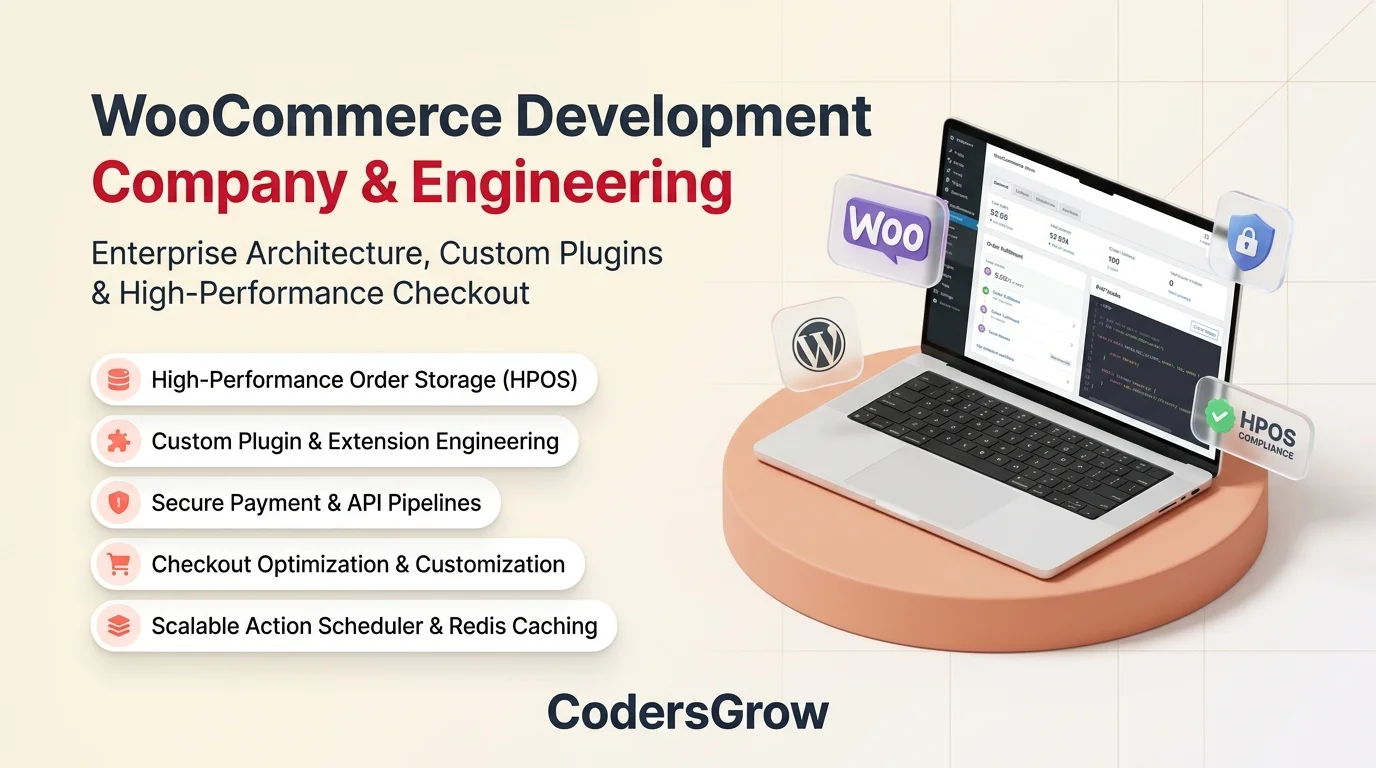
1. What Is WooCommerce Development?
WooCommerce development encompasses the end-to-end engineering, customization, integration, optimization, and maintenance of digital commerce platforms built on the open-source WooCommerce ecosystem. Unlike simple store setup—which involves installing off-the-shelf themes and adjusting admin dashboard toggles—professional WooCommerce development involves writing bespoke PHP, JavaScript (React/Block API), and database queries to solve distinct business problems that standard software cannot address.
The Spectrum of WooCommerce Engineering
Understanding what technical partners deliver requires distinguishing between four distinct tiers of platform engagement:
- Installing WooCommerce: The fundamental setup of WordPress, activating the WooCommerce plugin, and running the initial onboarding wizard. This requires zero programming knowledge and is completed in minutes.
- Configuring WooCommerce: Adjusting core settings: payment gateways, flat-rate shipping zones, tax tables, email templates, and standard product catalog attributes. This utilizes existing platform toggles without modifying underlying code.
- Customizing WooCommerce: Tailoring visual themes, altering layout templates via child themes, overriding template files, or writing lightweight filter hooks in
functions.phpto tweak front-end text strings or button placements. - Custom WooCommerce Development: Writing dedicated, standalone custom plugins and extensions; implementing High-Performance Order Storage (HPOS) custom tables; engineering headless or hybrid REST API pipelines; building custom checkout flows using the Cart & Checkout Blocks API; programming bespoke pricing algorithms; and integrating proprietary ERP, CRM, and warehouse management systems via resilient background workers.
+-----------------------------------------------------------------------+
|                      WOOCOMMERCE ARCHITECTURE STACK                   |
+-----------------------------------------------------------------------+
|                          CLIENT APPLICATION TIER                      |
|       (Classic PHP Templates / Gutenberg Cart & Checkout Blocks)       |
+-----------------------------------+-----------------------------------+
                                    |
                                    v
+-----------------------------------------------------------------------+
|                       WORDPRESS HOOK PIPELINE                         |
|     (Action Hooks: do_action / Filter Hooks: apply_filters / Nonces)  |
+-----------------------------------+-----------------------------------+
                                    |
                                    v
+-----------------------------------------------------------------------+
|                     WOOCOMMERCE CORE & CUSTOM CRUD                    |
|    (WC_Product, WC_Order, WC_Customer, WC_Data_Store, HPOS Tables)    |
+-----------------------------------+-----------------------------------+
                                    |
            +-----------------------+-----------------------+
            |                                               |
            v                                               v
+-----------------------+                       +-----------------------+
|  DATABASE TIER        |                       |   ASYNCHRONOUS TIER   |
| (wp_wc_orders / HPOS, |                       |  (Action Scheduler,   |
|  wp_posts, InnoDB,    |                       |   Redis Queue, Cron,  |
|  Redis Object Cache)  |                       |   Webhook Ingestion)  |
+-----------------------+                       +-----------+-----------+
                                                            |
                                                            v
                                                +-----------------------+
                                                | THIRD-PARTY SYSTEMS   |
                                                | (Stripe, ERPs, CRMs,  |
                                                |  Carrier APIs, 3PL)   |
                                                +-----------------------+
When Custom Development Becomes Necessary
Standard out-of-the-box WooCommerce handles simple direct-to-consumer catalog retail effectively. However, growing enterprises inevitably hit functional boundaries where custom web development services become essential:
- Complex Product Rules & Bundles: When selling configurable, composite, or customizable products with dynamic dimensional pricing, real-time file upload previews, or tiered quantity breaks that off-the-shelf plugins cannot calculate without conflicting with one another.
- Frictionless Checkout Funnels: When default multi-step checkouts result in cart abandonment, demanding customized one-page checkouts, slide-out express carts, localized address autocompletion, or rule-based upsell bumps.
- Bespoke Payment & Credit Workflows: When implementing split payments, multi-vendor marketplace payouts, custom net-30 invoicing, or proprietary localized payment gateways requiring cryptographic webhook validation.
- High-Concurrency Flash Sales: When standard WordPress database architectures lock tables under heavy transaction volume, requiring High-Performance Order Storage (HPOS), Redis object caching, and optimized database indexing to process hundreds of concurrent checkouts per minute.
- Enterprise System Synchronization: When catalog data, stock levels, wholesale customer discounts, and shipping tracking numbers must synchronize bi-directionally between WooCommerce and enterprise backends like SAP, NetSuite, Salesforce, or Microsoft Dynamics.
2. What to Look for in a WooCommerce Development Company
Evaluating a prospective WooCommerce development agency requires assessing technical competence, e-commerce domain expertise, and operational reliability. Because WooCommerce operates within the broader WordPress ecosystem, a qualified partner must demonstrate mastery across multiple interconnected disciplines.
                  EVALUATING A WOOCOMMERCE PARTNER
                                 |
    +----------------------------+----------------------------+
    |                            |                            |
    v                            v                            v
1. TECHNICAL MASTERY         2. E-COMMERCE DOMAIN         3. OPERATIONAL DISCIPLINE
- HPOS & Database Indexing   - Conversion funnel design   - Automated testing suites
- Custom Plugin Architecture - Inventory & tax states     - Staging & zero-downtime CI/CD
- Blocks API & Modern JS     - Payment tokenization       - Proactive SLA maintenance
WooCommerce Technical Expertise
Authentic platform specialization demands far more than basic theme editing:
- Modern WooCommerce Architecture & HPOS: They must build strictly for High-Performance Order Storage (HPOS). Storing orders inside the legacy
wp_postsandwp_postmetatables creates massive performance bottlenecks on high-volume stores. A qualified company writes queries usingwc_get_orders()and custom order data stores rather than direct post meta queries. - WordPress Core Standards: WooCommerce is deeply intertwined with WordPress. Developers must follow official WordPress Coding Standards (WPCS), leverage the Action and Filter hook system cleanly, utilize nonces for CSRF verification, enforce user capability checks (
current_user_can()), and avoid modifying core files or third-party plugins directly. - Modern PHP (8.1 – 8.3+): They should write strictly typed, modern object-oriented PHP with interfaces, dependency injection, and clean separation of concerns, avoiding outdated procedural spaghetti code.
- JavaScript & WooCommerce Blocks: The modern WooCommerce frontend is transitioning to React-powered Cart & Checkout Blocks. Your development partner should understand how to extend the Blocks API, build custom Gutenberg store blocks, and work with modern front-end tooling.
- Database Knowledge & Query Optimization: They must understand InnoDB table engines, composite database indexes, transient caching, and how to debug runaway queries using tools like Query Monitor and MySQL execution plans (
EXPLAIN). - Dedicated Custom Plugin Development: Rather than injecting hundreds of lines of fragile snippet code into a theme’s
functions.php, they encapsulate custom business logic into modular, maintainable, version-controlled plugins.
E-Commerce Domain Understanding
Writing clean code is insufficient if the developer does not understand commercial transactional mechanics. A qualified partner understands the nuances of:
- Product & Variation Complexity: How variable products, attribute taxonomies, and parent-child database relationships impact server memory and query counts on large catalogs.
- Order State Machine & Webhook Lifecycle: The difference between order statuses (
pending,processing,on-hold,completed,failed) and how asynchronous payment webhooks transition orders safely without duplicate inventory deductions. - Tax & Shipping Calculations: Nexus rules, destination-based taxation, shipping zones, volumetric weight algorithms, and how external tax engines (TaxJar, Avalara) interact with checkout performance.
- Refunds & Inventory Management: How automated stock holds, backorders, refunds, and payment gateway chargeback events must synchronize across inventory ledgers.
Business Understanding
A reliable partner functions as a technical consultant rather than a reactive ticket taker. When you propose a feature, they evaluate its impact on checkout friction, page latency, server infrastructure, and maintenance overhead. If a requested customization can be solved with a simpler, native approach that saves thousands of dollars in maintenance debt, an honest partner advises accordingly.
Communication & Development Practices
Professional e-commerce development requires disciplined operational hygiene:
- Version Control (Git): All code must reside in a private Git repository (GitHub, GitLab, Bitbucket) with structured branch management, descriptive commit messages, and protected production branches.
- Staging Environments: Code must never be tested directly on a live production store where active customers are checking out. Development occurs locally and deploys to an isolated staging mirror before release.
- Automated Testing: Critical paths—adding products to cart, applying coupons, calculating taxes, and completing checkout payments—should be protected by automated unit and integration tests.
- Clear Communication Cadence: Weekly sprint reviews, asynchronous video demos of working features, transparent ticket boards (Linear, Jira, ClickUp), and documented architectural decisions.
3. WooCommerce Development Services to Compare
When auditing a woocommerce development services company, you will encounter diverse service offerings. Understanding what each service involves ensures you hire the right team for your operational stage.
+---------------------------------------------------------------------------------------------------+
|                                 CORE WOOCOMMERCE SERVICE DOMAINS                                  |
+---------------------------------+---------------------------------+-------------------------------+
| 1. STORE & FEATURE ENGINEERING  | 2. CHECKOUT & INTEGRATIONS      | 3. PERFORMANCE & CODE CARE    |
+---------------------------------+---------------------------------+-------------------------------+
| - Custom WooCommerce Dev        | - Custom Checkout Architecture  | - Performance & HPOS Tuning   |
| - Custom Plugin & Extension Dev | - Payment Gateway Connectors    | - Enterprise Migration Srvs   |
| - Bespoke Theme Development     | - Carrier Shipping Integrations | - Ongoing Proactive Maint.    |
| - Subscription & B2B Workflows  | - ERP, CRM & Inventory Sync     | - Security Hardening & Audits |
+---------------------------------+---------------------------------+-------------------------------+
- Custom WooCommerce Store Development: Ground-up engineering of bespoke e-commerce platforms tailored to unique business models, brand identities, and purchasing funnels. Necessary when off-the-shelf templates cannot support your workflow.
- WooCommerce Customization Services: Targeted refactoring of existing store features through dedicated WooCommerce customization services—such as modifying product archives, building dynamic pricing tables, or adding custom meta fields.
- Custom Plugin & Extension Development: Engineering proprietary, isolated plugins using custom WooCommerce plugin development. Necessary when commercial plugins do not meet requirements or when you want to avoid recurring third-party license fees and plugin bloat.
- WooCommerce Theme Development: Building ultra-fast, accessible block themes (FSE) or modern child themes optimized specifically for Core Web Vitals, eliminating heavy commercial page builders that slow down mobile shopping.
- Custom Checkout & Cart Development: Redesigning the cart and checkout experience using the Cart & Checkout Blocks API, slide-out mini carts, custom checkout fields, one-click upsells, and address autocomplete to maximize checkout conversions.
- Payment Gateway & Split-Payment Integration: Connecting custom payment processors, localized gateway providers, tokenized card vaults, or multi-party split payouts with cryptographic webhook security.
- Shipping & Logistics Integrations: Integrating real-time carrier rate calculators (FedEx, UPS, DHL, EasyPost, ShipStation) with custom box-packing algorithms and automated fulfillment label generation.
- WooCommerce REST API & Third-Party Integrations: Building high-throughput data pipelines connecting WooCommerce with enterprise ERPs (SAP, NetSuite), CRMs (HubSpot, Salesforce), accounting suites (QuickBooks, Xero), and warehouse management systems.
- WooCommerce Subscription & Membership Development: Architecting recurring subscription billing funnels, automated billing retry schedules, dynamic access-control paywalls, and self-service customer management portals.
- Performance Optimization & HPOS Migration: Auditing slow queries, migrating order tables to High-Performance Order Storage (HPOS), configuring Redis object caches, and optimizing asset delivery to achieve sub-second server response times.
- Legacy Store Migration: Seamlessly migrating products, customer records, order histories, and SEO redirects from legacy platforms (Shopify, Magento, BigCommerce, OpenCart) to WooCommerce with zero transaction loss.
- Ongoing WooCommerce Maintenance & Security Audits: Providing proactive WordPress core, WooCommerce, and plugin updates in staging; monitoring uptime and checkout integrity; and hardening store defenses against brute-force attacks.
4. In-House vs. Agency vs. Freelance WooCommerce Developers
Sourcing engineering talent involves three primary engagement models: full-time in-house developers, independent freelance contractors, or a specialized WooCommerce development partner. Each model carries specific commercial and technical trade-offs.
| Factor | In-House Developer | Freelance Developer | Specialized Agency |
|---|---|---|---|
| Cost Model | High (Fixed Salary + Benefits + Taxes) | Low to Moderate (Hourly or Project) | Moderate to High (Sprint Retainers) |
| Hiring Overhead | Substantial (Recruiting, Onboarding) | Low (Fast contracting) | Zero Overhead (Immediate deployment) |
| Availability | 100% Dedicated to your company | Variable / Juggling other clients | Predictable Sprint Capacity & SLAs |
| Skill Breadth | Limited to the individual’s skillset | Often narrow or specialized | Cross-Functional (Backend, UI, QA, DevOps) |
| Scalability | Slow (Requires months to hire more) | Difficult to scale capacity | Elastic (Scale hours up or down) |
| Knowledge Continuity | Vulnerable to employee resignation | High risk if contractor vanishes | Documented & shared across agency team |
| Quality Assurance | Internal management required | Self-tested / User-tested | Multi-stage QA & Peer Code Reviews |
In-House WooCommerce Developers
An in-house engineer is completely immersed in your product and brand culture. However, full-time salaries, payroll taxes, benefits, equipment, and recruiting fees represent a major ongoing expense. Furthermore, a single in-house developer rarely excels simultaneously at custom PHP plugin architecture, modern React frontend blocks, high-concurrency database tuning, and automated CI/CD DevOps. If they resign, your store roadmap halts entirely.
Best For: High-revenue e-commerce brands with continuous, year-round engineering backlogs and internal technical leadership (CTO) to oversee development.
Freelance WooCommerce Developers
Independent contractors provide cost efficiency and speed of engagement for isolated, well-defined tasks. However, freelancers often split attention across multiple client deadlines, creating availability risks during emergency outages. Without internal technical expertise to audit their code, you also risk receiving quick-fix snippets that conflict with future WooCommerce core updates.
Best For: Small bug fixes, isolated styling adjustments, prototype MVPs, or stores that already have a technical manager directing code quality.
Specialized WooCommerce Development Agencies
A specialized agency provides a complete, multidisciplinary engineering team: senior backend PHP engineers, modern frontend block developers, QA testers, database specialists, and project managers. Agency code undergoes peer reviews and automated testing before deployment, and team redundancy guarantees that work continues uninterrupted even if an individual developer is sick. While agency retainers require higher investment than freelance rates, they provide stability, legal accountability, and enterprise execution.
Best For: Revenue-critical e-commerce stores, custom plugin initiatives, complex ERP/API integrations, and organizations that demand dependable, turnkey technical execution.
5. WooCommerce Development Company Comparison Framework
Use this objective evaluation framework when interviewing multiple prospective vendors. Score each provider based on verifiable technical evidence rather than sales rhetoric.
| Evaluation Factor | What to Inspect | Critical Questions to Ask the Vendor |
|---|---|---|
| WooCommerce Expertise | Track record with complex stores, High-Performance Order Storage (HPOS), custom hooks. | “How do you architect custom plugins to ensure 100% compatibility with High-Performance Order Storage (HPOS)?” |
| WordPress Knowledge | Adherence to WPCS, proper use of Actions/Filters, nonces, and capability checks. | “Can you explain your approach to sanitizing user inputs and escaping outputs in custom template overrides?” |
| Custom Development | Building bespoke functionality vs. stacking third-party plugins. | “When do you recommend writing a custom plugin rather than installing an existing commercial extension?” |
| Checkout Engineering | Experience with WooCommerce Cart & Checkout Blocks and checkout conversion optimization. | “How do you customize the modern WooCommerce checkout without breaking core validation or payment gateways?” |
| API & Integrations | WooCommerce REST API, Webhooks, ERP/CRM synchronization, idempotent data handling. | “How do you handle rate limits and failed webhook delivery when syncing inventory with an external ERP?” |
| Performance Optimization | Database indexing, Redis object caching, Action Scheduler queue monitoring, CDN assets. | “What is your process for auditing and eliminating slow queries caused by plugins on the cart and checkout pages?” |
| Testing & QA | Automated testing pipelines, end-to-end checkout verification, cross-device testing. | “What testing protocols do you execute before pushing an updated payment gateway or checkout feature to production?” |
| Deployment & Staging | Git workflow, staging environments, zero-downtime deployment pipelines. | “Describe your staging-to-production deployment workflow: How do you deploy updates without losing live customer orders?” |
| Code Documentation | Inline docblocks, repository READMEs, architecture decision records, API documentation. | “What documentation do you provide to ensure another engineering team could seamlessly maintain your custom code?” |
| Maintenance & Support | Post-launch warranty, update testing protocols, emergency incident SLAs. | “How do you test and deploy monthly WooCommerce minor and major core updates to prevent store breakage?” |
| IP & Ownership | 100% intellectual property transfer, direct Git repository access, no vendor lock-in. | “Will our business own 100% of the custom source code and repository access from day one of the engagement?” |
| Pricing Transparency | Detailed Statement of Work (SOW), clear scope boundaries, explicit change-order process. | “How do you define project scope boundaries, and what is your procedure when an unanticipated requirement emerges?” |
6. What CodersGrow Offers
As you evaluate prospective partners, CodersGrow is one specialized web development company you may consider for your e-commerce and web engineering requirements. CodersGrow focuses its engineering practice on modern WordPress, WooCommerce extension development, high-performance database architectures, and custom software solutions.
Rather than acting as a volume-driven outsourcer or a generic marketing agency, CodersGrow operates as a high-touch engineering partner dedicated to clean code, store stability, and transparent collaboration.
+-----------------------------------------------------------------------+
|                    CODERSGROW CORE CAPABILITY MATRIX                  |
+-----------------------------------------------------------------------+
|  CUSTOM WOOCOMMERCE & EXTENSION ENGINEERING                           |
|  - Custom Plugin Architecture with 100% HPOS Compatibility           |
|  - Bespoke Pricing, Bundling, and Subscription Logic                  |
|  - Custom Product Badges, Quantity Controls & Cart Rules             |
+-----------------------------------------------------------------------+
|  HIGH-CONVERSION CHECKOUT & API INTEGRATIONS                          |
|  - Checkout Customization via Modern Blocks API & Custom Gateways     |
|  - Bi-Directional ERP, CRM, and Inventory Synchronization             |
|  - Webhook Ingestion Pipelines with Idempotency & Replay Protection   |
+-----------------------------------------------------------------------+
|  HYBRID WOOCOMMERCE + LARAVEL ARCHITECTURES                           |
|  - Headless Storefront Integrations via Store API / REST              |
|  - Custom High-Performance Microservices for High-Volume Stores       |
|  - Custom Web Applications with custom software development           |
+-----------------------------------------------------------------------+
|  PERFORMANCE OPTIMIZATION & PROACTIVE STORE CARE                     |
|  - Database Query Profiling & Redis Object Caching                    |
|  - Safe Staging Core/Plugin Updates with Automated Verification       |
|  - Emergency Uptime Monitoring & Long-Term Code Refactoring           |
+-----------------------------------------------------------------------+
Core Capabilities
- Custom WooCommerce Development: Engineering custom store architectures, bespoke product configurators, and complex transactional logic built to scale cleanly.
- Custom Plugin & Extension Development: Building robust, isolated WordPress and WooCommerce plugins adhering strictly to WordPress Coding Standards (WPCS) and High-Performance Order Storage (HPOS).
- Checkout & Cart Customization: Engineering high-converting, streamlined checkout funnels using the Cart & Checkout Blocks API, custom billing/shipping fields, and localized payment gateway connectors.
- Enterprise API & ERP Integrations: Architecting automated, queue-backed data synchronization pipelines connecting WooCommerce to external inventory, accounting, and shipping systems.
- Performance Profiling & Database Tuning: Auditing database bottlenecks, eradicating unindexed postmeta queries, configuring Redis object caching, and optimizing store infrastructure for high-traffic sales.
- Hybrid WooCommerce & Laravel Solutions: Leveraging deep expertise in both ecosystems to build hybrid setups—using Laravel to power complex background processing, calculations, or portals connected to a WooCommerce storefront.
- Proactive Maintenance & Code Refactoring: Providing disciplined staging-to-production update testing, security hardening, database maintenance, and continuous store improvements through application maintenance and support.
7. How CodersGrow Approaches WooCommerce Projects
E-commerce software projects succeed when they follow a rigorous, multi-phase engineering lifecycle. CodersGrow approaches WooCommerce projects through a structured delivery process designed to eliminate production risks, prevent checkout errors, and protect client revenue.
+---------------------------------------------------------------------------------------------------+
|                            CODERSGROW E-COMMERCE DELIVERY LIFECYCLE                               |
+-------------------+-------------------+-------------------+-------------------+-------------------+
|  1. DISCOVERY     |  2. STORE AUDIT   |  3. ARCHITECTURE  |  4. DEVELOPMENT   |  5. QA & LAUNCH   |
| - Requirements    | - Plugin Conflict | - Schema Planning | - Modular Plugins | - Checkout Tests  |
| - Commercial Scope| - Query Profiling | - HPOS Modeling   | - Clean Hooks     | - Zero-Downtime   |
| - Edge Cases      | - Theme Overhead  | - API Contracts   | - Strict WPCS     | - SLA Maintenance |
+-------------------+-------------------+-------------------+-------------------+-------------------+
- Requirement Discovery & Commercial Mapping: We deconstruct your business model, customer purchasing funnels, inventory workflows, and compliance mandates upfront to ensure technical architecture supports commercial goals.
- Existing Store & Codebase Audit: For active stores, we perform a deep forensic audit: inspecting installed plugins for bloat or security vulnerabilities, profiling database query latency, auditing template overrides, and identifying plugin conflicts.
- Technical Architecture & Data Modeling: We plan custom database tables, order metadata structures, API payloads, and hook interactions before writing implementation code.
- Plugin & Theme Assessment: We evaluate whether existing third-party plugins can be retired and replaced with clean, lightweight custom code, immediately reducing server overhead and license expenses.
- Modular Custom Development: Development proceeds in isolated Git feature branches. Custom logic is encapsulated in dedicated plugins using modern PHP 8.x, strict typing, and sanitized inputs.
- API & Asynchronous Queue Integration: External connections are built defensively, offloading API calls to the WooCommerce Action Scheduler or background workers to prevent checkout latency.
- Multi-Device & Cross-Browser Testing: Interfaces are rigorously verified across mobile, tablet, and desktop viewports, ensuring cart drawers and checkout forms function without friction.
- Automated Checkout & Payment Testing: We run end-to-end sandbox transactions across all payment methods, verifying webhook callbacks, inventory adjustments, and customer confirmation emails.
- Performance Profiling & Object Caching: Profiling database queries on staging environments, ensuring zero N+1 queries exist on high-traffic shop, product, and cart pages.
- Isolated Staging Review: Stakeholders review fully functional features in a password-protected staging environment that mirrors live server configurations.
- Zero-Downtime Deployment: Deployments are orchestrated to prevent order loss: migrating database structures safely, compiling assets, and clearing caches without interrupting active shoppers.
- Proactive Post-Launch Monitoring: System telemetry, transaction success rates, and error logs are actively monitored post-launch to ensure complete operational stability.
8. A Professional WooCommerce Development Workflow
To understand what to expect from any professional partner, it is helpful to inspect the technical anatomy of an industry-standard WooCommerce development workflow.
+---------------------------------------------------------------------------------------+
|                              TECHNICAL DEVELOPMENT CYCLE                              |
+---------------------------------------------------------------------------------------+
| 1. User Story Breakdown -> 2. Hook & Schema Plan -> 3. Local Docker Environment       |
|                                       |                                               |
|                                       v                                               |
| 4. Write Custom Plugin Logic -> 5. Enforce WPCS Linters -> 6. Automated Unit Tests   |
|                                       |                                               |
|                                       v                                               |
| 7. Push to GitHub -> 8. CI Pipeline (PHPStan/WPCS) -> 9. Peer Pull Request Review     |
|                                       |                                               |
|                                       v                                               |
| 10. Merge to Staging -> 11. Staging Sandbox Testing -> 12. Production Zero-Downtime   |
+---------------------------------------------------------------------------------------+
Step 1: Requirement Analysis
Translating commercial requirements into technical specifications: determining whether a feature requires an Action hook, Filter hook, custom database table, or custom REST endpoint.
Step 2: Existing Store Audit
Auditing the active store environment to verify PHP version compatibility, active database table engines (InnoDB vs MyISAM), active WooCommerce template overrides, and active Action Scheduler queue health.
Step 3: Technical Planning
Defining architectural boundaries: mapping custom data structures, identifying dependencies, and establishing API contracts.
Step 4: UI/UX & Front-End Planning
Designing mobile-first shopping experiences that comply with Core Web Vitals, avoiding heavy third-party sliders and render-blocking scripts.
Step 5: Modular Development
Writing clean, maintainable code following WordPress and WooCommerce best practices. The following example demonstrates clean encapsulation of a custom checkout fee based on customer cart conditions:
// Example: Clean WooCommerce Action Hook adding conditional fee with validation
namespace CodersGrow\CustomFee;

class CartFeeHandler {
    public function init(): void {
        add_action('woocommerce_cart_calculate_fees', [$this, 'calculateCustomHandlingFee'], 20, 1);
    }

    public function calculateCustomHandlingFee(\WC_Cart $cart): void {
        if (is_admin() && !defined('DOING_AJAX')) {
            return;
        }

        // Verify cart contains heavy equipment category
        $hasHeavyItem = false;
        foreach ($cart->get_cart() as $cartItem) {
            if (has_term('heavy-freight', 'product_cat', $cartItem['product_id'])) {
                $hasHeavyItem = true;
                break;
            }
        }

        if ($hasHeavyItem) {
            $feeAmount = 25.00;
            $cart->add_fee(__('Special Freight Handling', 'codersgrow'), $feeAmount, true, 'standard');
        }
    }
}
Step 6: API & Integration Development
Integrating external APIs using the WordPress HTTP API (wp_remote_post()) with proper timeouts, nonces, and error handling.
Step 7: Testing & Quality Assurance
Executing comprehensive test scripts: verifying product variation pricing, tax calculations across diverse shipping zones, coupon discount edge cases, and successful payment webhooks.
Step 8: Security Review
Auditing all endpoints for proper nonce verification (check_admin_referer(), wp_verify_nonce()), capability checks (current_user_can('manage_woocommerce')), and strict output escaping (esc_html(), esc_attr(), wp_kses_post()).
Step 9: Performance Optimization
Using Query Monitor on staging to inspect SQL query counts, memory usage per request, and transient caching opportunities.
Step 10: Staging & Stakeholder Review
Providing the store owner with a staging preview URL to verify working features in a real-world checkout sandbox.
Step 11: Production Deployment
Automated zero-downtime deployment: pulling code via Git, running automated database migrations, clearing object caches, and verifying live transaction health.
Step 12: Ongoing Maintenance
Continuously testing and applying WordPress, WooCommerce, and PHP updates on staging before promoting to production.
9. Security & Code Quality in WooCommerce
E-commerce stores are high-priority targets for automated malicious attacks, credit card testing fraud, and data scrapers. Security is not an optional add-on; it must be engineered into every line of custom code, adhering to authoritative guidelines established by the OWASP Foundation.
+-----------------------------------------------------------------------------------------------+
|                                WOOCOMMERCE DEFENSE ARCHITECTURE                               |
+-------------------------------+-------------------------------+-------------------------------+
| 1. REQUEST & AUTH TIER        | 2. DATA HYGIENE TIER          | 3. INFRASTRUCTURE TIER        |
+-------------------------------+-------------------------------+-------------------------------+
| - Cryptographic Nonce Checks  | - Strict Input Sanitization   | - Parameterized $wpdb Queries |
| - User Capability Audits      | - Late Output Escaping        | - Cloudflare Rate Limiting    |
| - REST API Token / Secret Auth| - Whitelist Request Param.    | - Payment Tokenization (SCA)  |
| - Bot & Carding Fraud Defense | - Sanitized Webhook Payloads  | - Automated Dependency Audits |
+-------------------------------+-------------------------------+-------------------------------+
1. Input Sanitization and Late Output Escaping
Every piece of data entering the store must be sanitized, and every piece of data rendered to the screen must be escaped:
- Sanitization: Utilize core WordPress sanitization functions:
sanitize_text_field(),sanitize_email(),absint(), orwc_clean()on all incoming request data. - Late Escaping: Never output raw variables in HTML. Always escape at the point of rendering using
esc_html()for plain text,esc_attr()for HTML attributes,esc_url()for hyperlinks, andwp_kses_post()for formatted HTML blocks.
2. Cryptographic Nonces and User Capability Checks
Every state-changing HTTP request (form submission, AJAX call, checkout trigger) must verify a cryptographic nonce using wp_verify_nonce() to protect against Cross-Site Request Forgery (CSRF). Furthermore, administrative actions must explicitly verify that the active user possesses the required permissions (e.g. current_user_can('manage_woocommerce')) rather than assuming authenticated users are administrators.
3. SQL Injection Prevention
WooCommerce development should utilize native WooCommerce CRUD methods (such as wc_get_orders() or wc_get_products()) rather than direct SQL queries. When custom SQL queries are unavoidable, developers must strictly utilize the $wpdb->prepare() method to bind parameters securely:
// Secure, prepared custom database query using parameter binding
global $wpdb;
$safeCustomerId = absint($customerId);
$status = 'completed';

$results = $wpdb->get_results(
    $wpdb->prepare(
        "SELECT id, total_amount FROM {$wpdb->prefix}wc_orders WHERE customer_id = %d AND status = %s",
        $safeCustomerId,
        $status
    )
);
4. Payment Security & Tokenization
Never store raw credit card numbers or sensitive CVV codes on your WordPress database. Reputable stores use tokenized payment gateways (such as Stripe Elements or PayPal Vault) where payment credentials stream directly to PCI-DSS certified payment processors. Your WooCommerce database stores only non-sensitive tokens and transaction reference IDs.
5. Automated Dependency & Plugin Audits
The vast majority of WordPress security vulnerabilities originate from outdated, unmaintained third-party plugins. A professional development partner implements continuous dependency scanning, monitors the WPScan vulnerability database, and removes unnecessary plugins.
10. API & Third-Party Integrations
Modern e-commerce enterprises rely on interconnected digital ecosystems. A WooCommerce store typically functions as the commerce hub, exchanging live data with payment processors, ERP systems, fulfillment warehouses, and marketing suites.
                        RESILIENT INTEGRATION ARCHITECTURE
                                       |
    +----------------------------------+----------------------------------+
    |                                                                     |
    v                                                                     v
OUTBOUND DATA PIPELINES                                 INBOUND WEBHOOK PIPELINES
(Inventory Sync, Invoicing, Fulfillment)                (Stripe, ShipStation, Warehouse)
- Scheduled Action Scheduler jobs                       - Cryptographic signature validation
- Rate-limit aware exponential backoff                  - Immediate HTTP 200 acknowledgment
- Asynchronous batch processing                         - Background queue processing
- Forensic error logging (WC_Logger)                    - Idempotent event deduplication
Core Integration Categories
- Payment Gateways: Stripe, PayPal, Square, Adyen, Authorize.net (handling complex webhooks for authorization, capture, automated refunds, and 3D-Secure authentication).
- Enterprise ERP & Accounting: SAP, NetSuite, Microsoft Dynamics, QuickBooks, Xero (syncing inventory balances, wholesale customer ledgers, and sales tax reports).
- CRM & Marketing Automation: HubSpot, Klaviyo, Salesforce, ActiveCampaign (synchronizing customer purchasing behavior, abandoned cart events, and lifecycle segments).
- Logistics & Fulfillment (3PL): ShipStation, EasyPost, FedEx, UPS, custom warehouse management systems (generating shipping labels, customs manifests, and tracking numbers).
- Custom Business Applications: Connecting WooCommerce to custom WordPress development sites or dedicated Laravel applications via the WooCommerce REST API.
Integration Architectural Principles
- Never Block User Checkout: External API calls must never occur synchronously during the checkout submit action. If an external ERP takes 8 seconds to respond or experiences downtime, your customer faces a frozen screen. Order data should be saved locally, and external synchronization should be dispatched via the WooCommerce Action Scheduler.
- Idempotent Webhook Processing: External systems communicate status updates via webhooks. However, network interruptions can cause providers to dispatch the same webhook payload multiple times. A well-engineered integration records incoming webhook event IDs in a dedicated table, ensuring duplicate webhooks are acknowledged without executing duplicate business actions (such as completing an order twice).
- Rate Limiting & Exponential Backoff: External APIs enforce rate limits. Integrations should monitor HTTP status codes (such as HTTP 429 Too Many Requests) and automatically reschedule failed jobs with exponential backoff delays.
11. Performance Optimization & Scalability
In e-commerce, site speed directly dictates commercial conversion rates. A 100-millisecond delay in checkout responsiveness can measurably reduce conversion rates. Evaluating a development partner requires understanding the critical distinction between performance optimization and scalability:
- Performance Optimization: Making the existing store respond as rapidly as possible under current traffic (e.g. reducing page load from 2.8 seconds to 750 milliseconds through caching and query tuning).
- Scalability: The architectural capability of the store to handle exponentially increasing demand (e.g. expanding from 20 to 2,000 concurrent checkout transactions per minute during a Black Friday flash sale) without crashing the database or dropping orders.
+-----------------------------------------------------------------------------------------------+
|                            PERFORMANCE & SCALABILITY ROADMAP                                  |
+-------------------------------+-------------------------------+-------------------------------+
| 1. DATABASE TIER              | 2. APPLICATION & CACHE TIER   | 3. INFRASTRUCTURE TIER        |
+-------------------------------+-------------------------------+-------------------------------+
| - High-Performance Order      | - Redis persistent object     | - Enterprise cloud hosting    |
|   Storage (HPOS) migration    |   caching (drop-in)           |   (isolated PHP-FPM workers)  |
| - Eliminate postmeta N+1      | - Action Scheduler queue      | - Dedicated database cluster  |
| - Add composite table indexes |   optimization                | - Edge CDN caching (Cloudflare|
| - Scheduled transient pruning | - Disable cart fragments AJAX |   Enterprise, full page cache)|
+-------------------------------+-------------------------------+-------------------------------+
High-Performance Order Storage (HPOS)
Historically, WooCommerce stored orders inside WordPress’s generic wp_posts and wp_postmeta tables alongside blog posts and pages. For a store with 50,000 orders, this generated millions of postmeta rows, causing database queries to crawl. High-Performance Order Storage (HPOS) moves orders into dedicated, indexed relational tables (wp_wc_orders, wp_wc_order_addresses, wp_wc_order_operational_data), drastically speeding up order processing and eliminating table locking.
Redis Persistent Object Caching
While standard page caching works wonders for static blog posts, dynamic e-commerce cart, checkout, and customer account pages cannot be cached statically. A persistent Redis object cache stores complex database query results in RAM, allowing WooCommerce to retrieve customer cart sessions and product attributes instantaneously without querying the disk-based MySQL database.
Eliminating the AJAX Cart Fragments Bottleneck
On un-optimized stores, WooCommerce fires an AJAX request (wc-ajax=get_refreshed_fragments) on every page load to update the mini-cart icon. On high-traffic stores, this can generate thousands of uncacheable PHP executions that overwhelm server resources. An experienced partner optimizes or replaces cart fragments with modern client-side storage (localStorage) or lightweight REST endpoints.
12. Maintenance, Upgrades, and Long-Term Code Care
An e-commerce store is an evolving software asset that requires continuous maintenance. A store that functions perfectly today will inevitably accumulate technical debt and security risks if left unmanaged.
                               THE STORE CARE LIFECYCLE
                                          |
        +---------------------------------+---------------------------------+
        |                                                                   |
        v                                                                   v
ACTIVE VALUE CREATION                                   MAINTENANCE & DEBT MITIGATION
- Conversion rate optimization (CRO)                    - Monthly core, Woo & plugin updates
- New feature sprint iterations                         - Automated staging regression tests
- Checkout funnel A/B testing                           - Database index maintenance & vacuuming
- Expanded API connectors & channels                    - Payment gateway API version upgrades
Why Continuous E-Commerce Maintenance Is Essential
- Rapid Platform Evolution: WordPress core, WooCommerce, and active payment gateway extensions release frequent minor updates and security patches. Furthermore, payment providers (Stripe, PayPal) regularly update API specifications and security mandates (such as Strong Customer Authentication).
- Preventing Catastrophic Update Conflicts: Applying major WooCommerce updates directly to a live production store without staging testing frequently breaks custom template overrides and checkout gateways, leading to hours of lost sales.
- Database Hygiene: Over time, WooCommerce databases accumulate tens of thousands of expired transient records, orphaned order metadata, and Action Scheduler logs that slow down query performance if not systematically purged.
The Three Engagement Models
- One-Time Build & Handover: The agency delivers the store according to a fixed scope with a brief post-launch warranty period (30–60 days). The client assumes responsibility for ongoing maintenance.
- Managed Store Care Retainer: The agency actively manages staging environments, performs scheduled monthly plugin and core updates, monitors checkout uptime 24/7, and performs regular database maintenance.
- Strategic Growth Partnership: The agency functions as an embedded engineering team. In addition to technical maintenance, they actively develop new features, optimize conversion funnels, and refine integrations month after month.
At CodersGrow, we support e-commerce clients across all three engagement models, providing structured ongoing store maintenance and performance monitoring to ensure digital storefronts remain stable and profitable.
13. Factors That Influence WooCommerce Development Pricing
One of the most frequent questions e-commerce founders ask is: “How much does custom WooCommerce development cost?”
There is no legitimate one-size-fits-all fixed price because development costs directly reflect project scope, functional complexity, and architectural requirements. A clean, streamlined store with 20 standard physical products bears no technical or financial resemblance to an international multi-currency marketplace with 25,000 variable SKUs, custom product configurators, and real-time ERP synchronization.
                          PRICING INFLUENCE MATRIX
                                     |
    +--------------------------------+--------------------------------+
    |                                                                 |
    v                                                                 v
TECHNICAL COMPLEXITY FACTORS                            COMMERCIAL & SCOPE FACTORS
- Custom plugin & extension dev                          - Catalog volume & product variations
- Headless or custom Blocks checkout                    - Number of shipping zones & tax rules
- Depth & volatility of ERP/CRM APIs                    - Legacy store migration data volume
- High-concurrency HPOS optimization                    - Level of bespoke UI/UX Figma design
- Multi-currency / multi-language logic                 - Stringency of automated QA test suites
Core Cost Drivers in WooCommerce Projects
- Product Catalog Structure: Simple single-price products are straightforward. Highly complex variable products with dozens of attribute combinations, dynamic measurement calculators, or composite bundles require significant backend and frontend engineering.
- Custom Plugin vs. Off-the-Shelf: Leveraging well-supported commercial extensions is cost-effective. Writing custom, proprietary plugins for bespoke business workflows requires dedicated architecture, development, and testing hours.
- Checkout Customization: Standard native checkout requires minimal configuration. Custom multi-step checkouts, slide-out carts, and rule-based upsell funnels require advanced JavaScript and PHP engineering.
- Third-Party Integrations: Standard payment gateways (Stripe) require minimal hours. Synchronizing data with legacy enterprise ERPs (SAP, NetSuite) or custom warehouse APIs often requires dozens of hours of custom middleware development.
- Data Migration Requirements: Migrating years of historical customer records, hashed passwords, order records, and SEO URL redirects from Magento, Shopify, or BigCommerce requires custom migration scripts and rigorous validation.
Why the Lowest Quote Is Rarely the Lowest Total Cost
When reviewing proposals, exercise extreme caution regarding bids that seem too good to be true. In e-commerce development, unrealistically cheap quotes almost universally indicate hidden commercial risks: developers who cut corners by installing 40+ unvetted plugins that conflict with one another; zero automated checkout testing; hardcoded styles that break on mobile viewports; and no staging environment. Within a few months, the store accumulates severe performance debt, and the business owner ends up paying a reputable agency twice as much to rebuild the store properly.
14. 20 Questions to Ask Before Hiring a WooCommerce Company
Before committing capital to a woocommerce development company, conduct a thorough technical and operational interview. Use these 20 targeted questions to evaluate their expertise and business alignment:
+---------------------------------------------------------------------------------------------------+
|                              20-POINT VENDOR AUDIT CHECKLIST                                      |
+----+----------------------------------------------+----+------------------------------------------+
| #  | EVALUATION QUESTION                          | #  | EVALUATION QUESTION                      |
+----+----------------------------------------------+----+------------------------------------------+
| 01 | Primary framework dedication & WP expertise  | 11 | Security & OWASP compliance standards    |
| 02 | Track record with high-volume Woo stores     | 12 | Post-launch support SLAs & warranties    |
| 03 | Experience building custom plugins           | 13 | Change-order & scope management protocols|
| 04 | Approach to custom checkout development      | 14 | Estimation accuracy & billing methodology|
| 05 | Methodology for performance & query tuning   | 15 | Technical documentation deliverables     |
| 06 | Automated checkout & payment testing QA      | 16 | Strategy for auditing existing codebases |
| 07 | Resilient third-party API & ERP integrations | 17 | Working with existing themes & plugins   |
| 08 | Team composition & senior architect oversight| 18 | Prevention of plugin bloat & conflicts   |
| 09 | Source control & 100% IP ownership transfer  | 19 | Testing protocols for major Woo updates  |
| 10 | Staging environments & deployment pipelines  | 20 | When to build custom vs. buy extensions  |
+----+----------------------------------------------+----+------------------------------------------+
- How much dedicated experience does your team have with modern WooCommerce? Verify whether WooCommerce is their primary core practice or just an occasional side service.
- Can you demonstrate relevant WooCommerce stores you have engineered? Ask to inspect production stores they built, focusing on checkout speed, responsive behavior, and architectural complexity.
- Do you build custom WooCommerce plugins from scratch? Confirm their capability to engineer standalone, modular plugins adhering to WordPress Coding Standards.
- How do you approach custom checkout requirements? Ask whether they leverage the modern Cart & Checkout Blocks API or override classic templates, and how they ensure checkout reliability.
- What is your methodology for WooCommerce performance optimization? Look for specific technical mentions of High-Performance Order Storage (HPOS), Redis object caching, query profiling, and Action Scheduler tuning.
- How do you test payment and checkout functionality? Inquire about automated end-to-end testing, sandbox payment gateways, and webhook verification.
- How do you handle third-party API and ERP integrations? Ensure they utilize asynchronous queues (Action Scheduler) rather than executing slow HTTP requests during user checkout.
- Who will specifically write the code for our project? Confirm whether code is written by experienced in-house developers or outsourced to undisclosed subcontractors.
- How do you manage source code and intellectual property ownership? Confirm in writing that your company will own 100% of the custom source code and repository access from day one.
- What staging and deployment workflow do you enforce? Verify that updates are tested on isolated staging environments with automated zero-downtime deployment pipelines.
- What security practices do you follow to protect customer and payment data? Inquire about nonces, input sanitization, late output escaping, SQL parameter binding, and PCI-compliant tokenization.
- What happens after the store is launched? Clarify warranty periods, ongoing maintenance retainers, and guaranteed emergency response times for checkout outages.
- How are project scope changes handled? Understand their change-order management process to ensure cost transparency when requirements evolve.
- How is the project estimate calculated and billed? Determine whether the contract is Fixed-Price Milestone, Time & Materials, or dedicated bi-weekly sprint retainers.
- What technical documentation will you deliver? Confirm they provide comprehensive documentation: repository READMEs, setup guides, and architecture decision records.
- How do you approach working with an existing, messy WooCommerce store? Ask how they perform technical audits to identify legacy debt and plugin conflicts without breaking live operations.
- Can you work with our existing themes and plugins? Verify their ability to adapt to your established toolchain while providing constructive recommendations for improvement.
- How do you prevent plugin bloat and plugin conflicts? Ask what criteria they use before approving a third-party plugin and how they test for compatibility.
- How do you handle major WooCommerce core updates? Inquire about their update testing protocol on staging environments to ensure store continuity.
- How do you determine whether to buy an existing extension or build custom code? A qualified partner provides balanced advice, recommending commercial plugins when mature and custom engineering when commercial options are bloated or inflexible.
15. Why Choose CodersGrow as Your WooCommerce Partner
Selecting a WooCommerce development partner requires finding an engineering team whose technical standards, communication discipline, and commercial mindset align with your business objectives.
CodersGrow is built for e-commerce brands, growing retailers, and digital agencies that value clean architecture, operational stability, and transparent collaboration over marketing exaggeration. We do not claim to be the cheapest developer on the web, nor do we make unrealistic guarantees about instant sales increases. Instead, we focus on engineering reliable, high-performance digital commerce software that helps your business scale securely.
+-----------------------------------------------------------------------------------------------+
|                               WHY BUSINESSES PARTNER WITH CODERSGROW                          |
+-------------------------------+-------------------------------+-------------------------------+
| 1. SPECIALIZED ENGINEERING    | 2. ARCHITECTURAL RIGOR        | 3. TRANSPARENT COLLABORATION  |
+-------------------------------+-------------------------------+-------------------------------+
| - Dedicated Woo & WP focus    | - 100% HPOS & WPCS compliance | - Direct developer access     |
| - Custom plugin development   | - Defensive API & queue arch. | - 100% IP & Git ownership     |
| - Complex checkout funnels    | - Automated checkout testing  | - Clear, predictable billing  |
| - Hybrid WooCommerce+Laravel  | - Zero-downtime CI/CD         | - Honest, consultative advice |
+-------------------------------+-------------------------------+-------------------------------+
Where CodersGrow Is an Ideal Fit
- Custom Storefronts & Bespoke Functionality: If you need tailored product configurators, complex subscription pricing, or unique purchasing workflows that off-the-shelf plugins cannot accommodate.
- High-Performance Checkout Funnels: If you want to optimize your cart and checkout experience using modern WooCommerce blocks, reducing checkout friction and maximizing conversion rates.
- Enterprise System Integrations: If you need reliable, queue-backed synchronization between your WooCommerce store and external ERP, CRM, inventory, or logistics systems.
- Storefront Rescuing & Performance Tuning: If your active store is suffering from slow page loads, database query bottlenecks, checkout crashes, or plugin conflicts, and you need an experienced team to audit, stabilize, and optimize the codebase.
- Long-Term Engineering & Maintenance Partnerships: If you are seeking a dependable technical partner who will maintain your store’s security, test core updates on staging, and continuously evolve your e-commerce features month after month.
Start a Conversation About Your Project
Every successful e-commerce development initiative starts with a clear, collaborative discussion of business requirements, technical feasibility, and architectural planning.
If you are planning a new digital storefront, looking to refactor an existing store, or seeking an experienced woocommerce development company to support your long-term roadmap, contact CodersGrow to share your project requirements. Our technical team will review your goals, discuss the optimal architectural approach, and help you determine whether our team is the right fit for your e-commerce journey.
Frequently Asked Questions
What does a WooCommerce development company do?
A WooCommerce development company designs, builds, customizes, integrates, and maintains e-commerce stores on the WordPress platform. Their responsibilities include custom theme and plugin development, checkout optimization, High-Performance Order Storage (HPOS) database tuning, payment gateway integrations, ERP/CRM synchronization, security hardening, and ongoing technical support to ensure the digital storefront operates fast, securely, and reliably.
How much does custom WooCommerce development cost?
WooCommerce development costs vary based on project scope, catalog complexity, custom plugin requirements, third-party integrations, and UI/UX design depth. Simple store setups or targeted customizations typically range from $3,000 to $10,000, while full-scale custom store builds, complex B2B wholesale portals, or enterprise ERP integrations generally range from $15,000 to $50,000 or more. Reputable agencies quote based on detailed functional specifications rather than arbitrary flat fees.
How long does a typical WooCommerce project take?
Project timelines depend on technical depth and functional scope. A targeted store customization or custom plugin typically takes 3 to 6 weeks. A complete ground-up custom store build with bespoke design, payment integrations, and data migration generally requires 8 to 16 weeks. A disciplined agency breaks delivery into bi-weekly sprint milestones with working demos at each phase.
Should I hire a freelance WooCommerce developer or a development company?
Freelancers are cost-effective for small, isolated bug fixes or styling adjustments where you have internal technical leadership to review their work. However, for revenue-critical stores, custom extensions, or complex migrations, a specialized development company is preferred. An agency provides cross-functional talent (backend, frontend, QA, DevOps), formal development processes, and guaranteed team redundancy without the risk of an individual contractor becoming unavailable.
What is custom WooCommerce development?
Custom WooCommerce development involves writing proprietary PHP, JavaScript, and database queries to create unique e-commerce functionality that off-the-shelf plugins and themes cannot provide. This includes engineering bespoke plugins, creating custom checkout funnels, designing unique product configurators, and building custom API connections between WooCommerce and enterprise backends.
When should I build a custom WooCommerce plugin instead of buying one?
You should build a custom plugin when commercial extensions do not meet your business requirements, when existing plugins are bloated with unnecessary features that slow down your site, when multiple third-party plugins conflict with each other, or when you want to eliminate costly recurring annual license fees while retaining 100% intellectual property ownership of your core business logic.
Can WooCommerce integrate with third-party ERP and CRM systems?
Yes. WooCommerce features a comprehensive REST API and webhook system that allows bi-directional integration with any external system supporting modern web standards. Experienced development partners utilize background workers (via the WooCommerce Action Scheduler) to synchronize products, stock levels, orders, and customer records asynchronously without slowing down user checkout performance.
Can an existing WooCommerce store be customized without losing data?
Yes. Experienced developers work strictly on local or staging copies of your store, developing custom plugins and template overrides in version-controlled Git branches. Updates and database migrations are thoroughly tested on staging before being deployed to production using zero-downtime deployment pipelines that protect live customer carts and order transactions.
How do I improve WooCommerce performance and checkout speed?
WooCommerce performance is improved by migrating to High-Performance Order Storage (HPOS), implementing a persistent Redis object cache, optimizing database indexes, eliminating the uncacheable AJAX cart fragments bottleneck, offloading background sync tasks to the Action Scheduler, auditing slow third-party plugins using Query Monitor, and serving media through a global CDN.
Does a WooCommerce store require ongoing maintenance?
Yes. An e-commerce store is an active commercial software asset. Ongoing maintenance is essential to apply security patches, test WordPress and WooCommerce core updates on staging before production, maintain database indexes, update third-party payment gateway connections before API endpoints are deprecated, and resolve edge-case checkout bugs before they impact revenue.
How do I choose the right WooCommerce development company?
Choose a company that demonstrates deep technical mastery of WordPress and WooCommerce (HPOS, modern PHP 8.x, clean hook architecture), possesses strong e-commerce domain understanding, writes automated tests, utilizes disciplined staging and CI/CD deployment pipelines, provides transparent pricing and communication, and guarantees 100% client intellectual property ownership.
Can WooCommerce support complex enterprise and B2B requirements?
Yes. When engineered with solid architectural principles, WooCommerce powers enterprise-grade e-commerce platforms. It accommodates tiered B2B wholesale pricing, custom quotation workflows, multi-warehouse inventory routing, customer-specific credit terms, international multi-currency checkouts, and high-concurrency flash sales with ease.